Source: Small (Weinheim an Der Bergstrasse, Germany), by Hiroshi Yuzawa; Tetsuji Itoh; Thidarut Laochai; Nadnudda Rodthongkum; Hirotomo Nishihara (September 8, 2026). AI-generated summary by biochip.com, published . Not independently reviewed.
Key takeaways
- Researchers propose treating carbon electrodes as hierarchically designable reaction fields rather than passive conductive supports.
- The framework links defects, edge sites, pore architecture, and electron pathways to electrochemical biosensor performance.
- The perspective does not establish a single standardized carbon-electrode design or report validation in clinical samples.
A perspective in Small argues that carbon electrodes should be engineered as active reaction fields, not treated as interchangeable conductive supports in electrochemical biosensors. Hiroshi Yuzawa and collaborators at Tohoku University, AIST, Thammasat University, and Chulalongkorn University outline how defects, edge chemistry, pores, and electron pathways can jointly shape a sensor's signal. The proposal matters because carbon is widely used in low-cost, flexible, and miniaturized sensors, yet inconsistent fabrication can make performance hard to reproduce. Rather than offering a single new device, the team presents a structure-guided framework for designing more reliable carbon sensing interfaces.
From Conductive Support to Reaction Field
An electrochemical biosensor translates molecular recognition into an electrical measurement. A biological recognition element, such as an enzyme or antibody, interacts with a target molecule, while the electrode converts the resulting chemical event into a measurable current or voltage.
Carbon is attractive for this job because it is conductive, chemically stable, lightweight, and mechanically flexible. Graphene can provide continuous conductive paths in thin films, carbon nanotubes can form flexible networks, carbon black is inexpensive and scalable, and porous carbon can create a large reaction area.
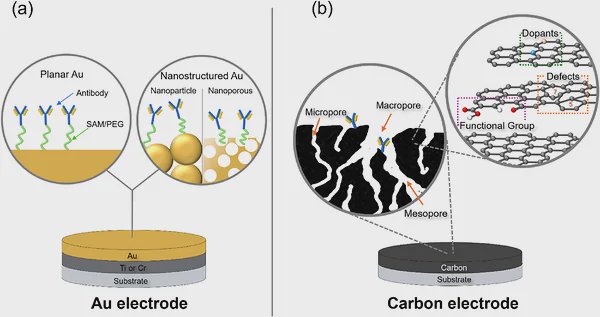
Yet the same broad label, “carbon electrode,” can hide major differences. The carbon's graphitic order, defects, functional groups, pore structure, particle shape, film thickness, binder, pretreatment, and drying conditions can all affect the interface where sensing occurs. The researchers argue that these coupled features should be deliberately controlled as a reaction field.
What Makes Carbon Hard to Control
A gold electrode often starts with a comparatively defined surface and established gold-sulfur chemistry for attaching molecules. Carbon surfaces are more heterogeneous. Even electrodes made from the same nominal material can differ after fabrication or pretreatment, changing their interfacial behavior.
That variability can influence electron transfer, the movement of molecules through a film, attachment of biomolecules, and local concentration near the electrode. It can also contribute to batch variation, surface aging, fouling, background capacitive currents, and film delamination. Capacitive current is an electrical background signal caused by charge accumulating at an interface, rather than by the target chemical reaction itself.
The team frames the challenge as one of connecting several scales of design. Atomic-scale sites and chemical groups influence molecular interactions, while pores and particle arrangements govern mass transport, and the final electrode film determines how the sensor works in a real sample.
Design Variables That Work Together
The proposed framework treats crystallinity, heteroatom dopants, edge sites, and pore size as core variables. A heteroatom dopant is an atom other than carbon, introduced into a carbon framework to alter its chemical and electronic behavior. Edge-site termination refers to the chemical groups located where carbon layers end, which can affect how molecules bind and how charges move.
An everyday comparison is a city street network. The chemical makeup of intersections affects where people stop, the width and connectivity of streets affect traffic flow, and the overall map determines whether travelers reach their destination efficiently. In a carbon electrode, active sites, pores, and conductive pathways similarly work together to determine whether target molecules arrive, bind, and generate a distinguishable signal.
The perspective also highlights analytical tools that could make these relationships more measurable. High-temperature-range temperature-programmed desorption can examine how species leave a material as it is heated, while solid-state nuclear magnetic resonance can probe chemical environments within solids. Used alongside electrochemical measurements, these methods may help tie carbon structure to molecular recognition, charge storage, and signal transduction.
Why This Matters
The authors point to studies in which controlling particle morphology, active-site arrangement, and transparent electrode architectures improved more than sensitivity. Such choices can also affect response stability, signal discrimination, and multimodal readout, meaning a sensor can deliver more than one type of useful measurement.
For practical biosensors, a low limit of detection alone is not enough. A sensor must also respond predictably, resist interference in complex samples, and be manufacturable with consistent results. Treating response time and detection limits as outcomes of reaction-field design could shift development away from trial-and-error adjustments to coatings and pretreatments.
The next step is to turn this organizing idea into reproducible design rules that link specific carbon structures and fabrication methods to sensor performance. That would help researchers compare carbon platforms on more than headline sensitivity and could support more dependable flexible, wearable, paper-based, and miniaturized electrochemical sensors.
Topics: Biosensors
Start here: Biosensors explained
Related articles
- Electric-Field-Assisted Enrichment and Electrochemical Detection of Gram-Positive Bacteria Using an FEM-Guided Interdigitated Electrode Biosensor
- Optical and Electrochemical Biosensors Using Electrochemically Etched Porous Silicon
- Physics-informed machine learning for robust calibration and physiological validation of wearable electrochemical sweat biosensors for metabolite monitoring
- Design of a Novel Diamine Biosensor to Guide the Engineering of Escherichia coli for Cadaverine Overproduction