Source: Materials, written by Tadej Emeršič; Uroš Tkalec (October 16, 2026). AI-generated summary by biochip.com, published . Not independently reviewed.
Key takeaways
- Patterned electrodes reshaped, split and nucleated dowser and chiral domains in flowing 5CB liquid crystal.
- Under steady flow, new domains appeared every 0.5 to 2 seconds; pulsating flow produced larger individual domains.
- The electrode layouts produced different field distributions, so comparisons between configurations were qualitative.
Researchers have used patterned electrodes to steer liquid-crystal flow states inside a microfluidic channel. Tadej Emeršič, Uroš Tkalec and colleagues applied in-plane electric fields to reshape, split and create small moving regions called dowser domains. The team also produced chiral streams and found that field direction and flow conditions helped determine which patterns formed. The work demonstrates a way to control structures inside a microfluidic device using localized electrical signals.
Electric fields meet flowing liquid crystals
A nematic liquid crystal is a fluid whose molecules tend to point in a shared direction, rather like a crowd whose members all face roughly the same way. In the researchers’ device, pressure pushed the liquid crystal 5CB through narrow channels while electric fields acted on its molecular orientation.
The team built the channels from polydimethylsiloxane, a flexible material used in microfluidics, and glass coated with indium tin oxide electrodes. The channels were about 12 micrometers high, 100 micrometers wide and 20 millimeters long. Interdigitated electrodes, patterned as alternating fingers, generated fields across or along the channel.
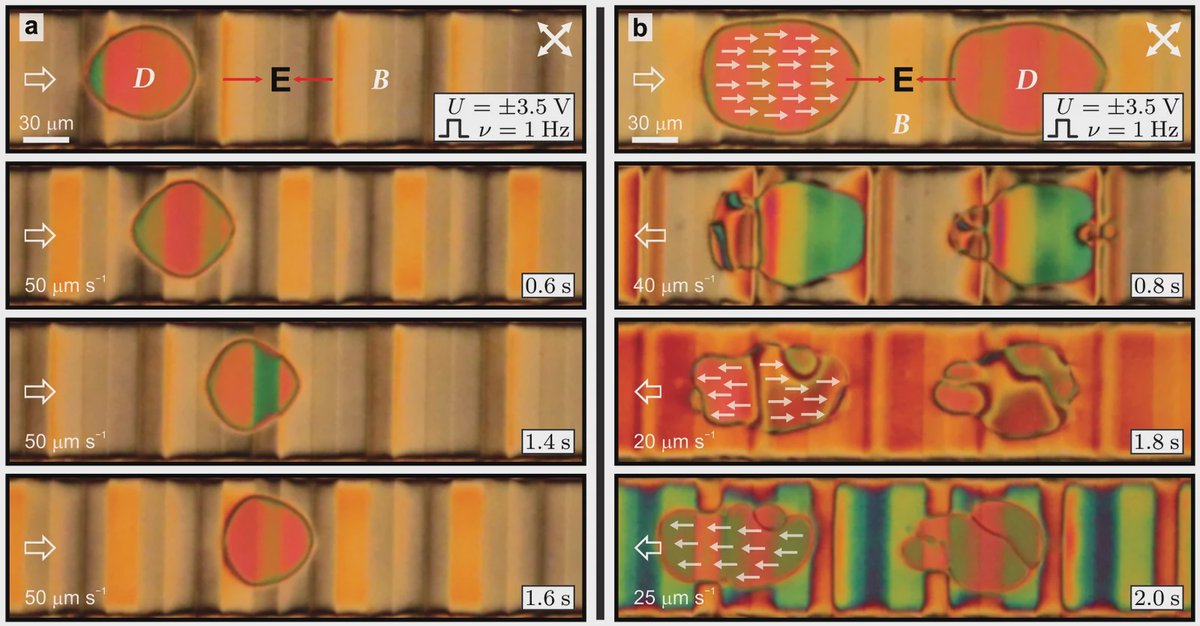
The researchers applied a 1-hertz bipolar square-wave voltage at peak amplitudes of 3.5, 5 or 9 volts. They tested flow conditions that included domain velocities of about 50 to 80 micrometers per second, and watched the liquid crystal under a microscope between crossed polarizers. This optical setup reveals changes in the material’s orientation because differently aligned regions alter how light passes through.
Reshaping domains on demand
At the tested flow speeds, the electric fields could reversibly reshape existing dowser domains, divide them into smaller regions, or trigger new dowser and chiral domains. A dowser domain is a localized, flow-aligned pattern in the liquid crystal, bounded by a loop-shaped defect. The field did not produce just one response: its orientation and the flow conditions influenced whether the channel contained paired domains, a single domain or a chiral stream.
Under steady flow, new domains appeared at intervals of roughly 0.5 to 2 seconds. Pairing the electrical field with pulsating flow produced larger individual domains. Together, the results show that a field can act as a localized trigger while fluid motion helps determine how the resulting pattern develops.
What the electrode design means
The two electrode layouts generated different field strengths and penetration depths, so the researchers reported applied voltage rather than treating the field as uniform throughout the channel. They also cautioned that the different layouts were not directly matched, making comparisons between them qualitative. Their electrostatic calculation provided a reference for the field distribution, but did not describe how ionic screening might change the field over time.
Why This Matters
Liquid-crystal flow combines fluid motion with molecular alignment and defects, creating patterns that can be changed by external forces. Being able to tune those patterns electrically adds a control method to microfluidic systems, where small volumes move through confined channels. The work points to possible integration in optofluidic and lab-on-a-chip devices, though it does not demonstrate a biological assay or a sensing application.
Next, the approach could be explored as a way to organize or redirect liquid-crystal structures within more complex microfluidic layouts. The experiments establish electrical control in the tested channel configurations; whether the method can be adapted to specific device functions will depend on further work.
Topics: Microfluidics
Start here: Microfluidics explained
Related articles
- Systematic standardization of organ-on-a-chip under controlled flow conditions: Use case with Caki-1 and A549 cell lines
- Facile Fabrication of Polymeric Microfluidic Channel Based on Fibrous Mold Base Using Near-Field Electrospinning
- Three-Dimensional Characterization of AC Electrothermal Flow in Microfluidic Devices
- AI Chip Helps Find Rare Cancer Cells in Blood in New Liquid Biopsy Study