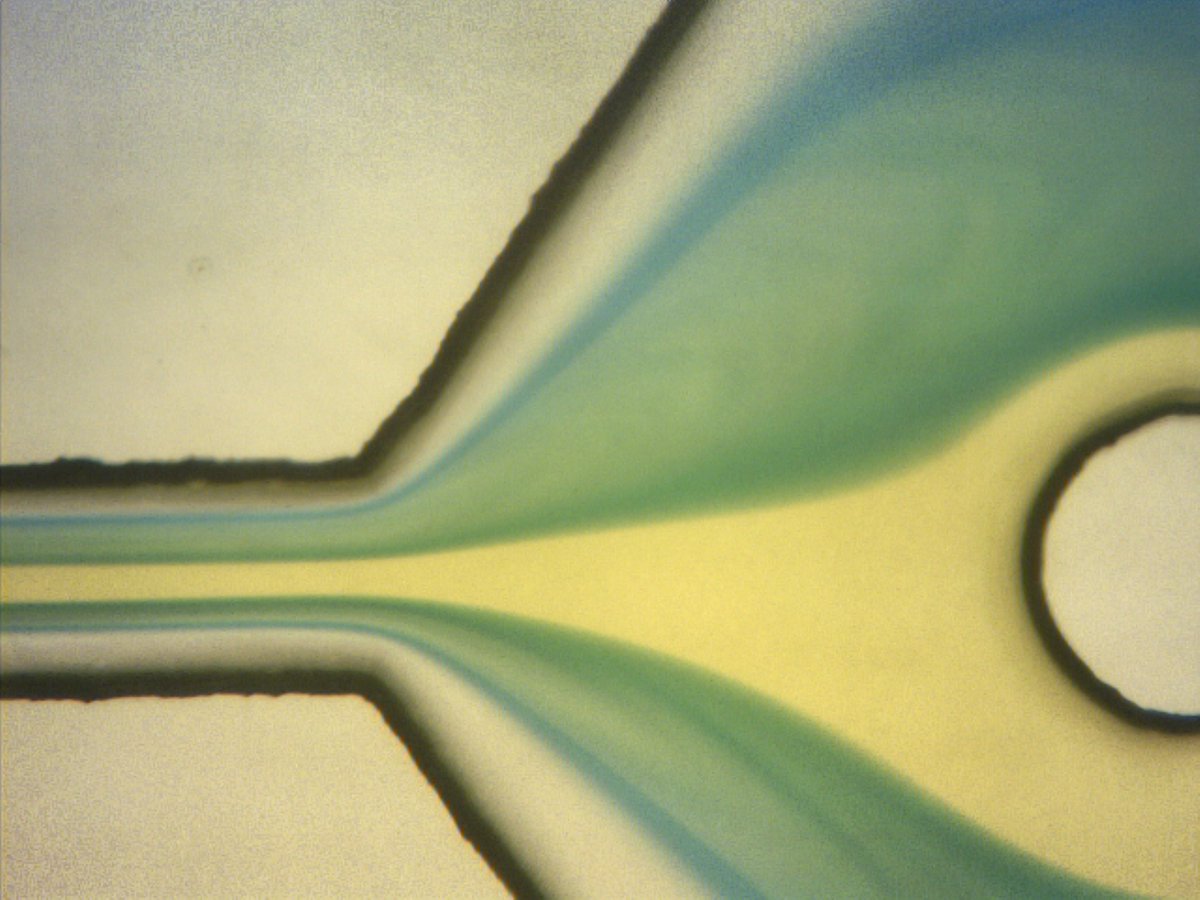

Source: Journal of Robotics and Mechatronics, written by Hiroki Fukunaga; Naotomo Tottori; Shinya Sakuma; Yoko Yamanishi (October 20, 2026). AI-generated summary by biochip.com, published . Not independently reviewed.
Key takeaways
- A Kyushu University team integrated droplet separation and ionic gelation in a deterministic lateral displacement micropillar array.
- With NIH3T3-3-4 cells, the device produced single-cell alginate microgels with 64% reported purity and 53% separation efficiency.
- The proof-of-concept used one model cell line and does not establish performance with other cell types or in downstream applications.
Researchers at Kyushu University have built a microfluidic device that separates cell-containing droplets and gels them in one continuous process. The team used a deterministic lateral displacement micropillar array, a tiny obstacle course that guides particles along different paths, to produce alginate microgels containing single cells. In a demonstration with NIH3T3-3-4 cells, 64% of the resulting microgels met the reported purity measure, while separation efficiency was 53%. Combining these steps on one chip could simplify the production of small, cell-containing compartments used to study differences between individual cells.
Why single-cell packaging is difficult
Alginate microgels are tiny gel compartments that can hold cells in a defined environment. Researchers use them in three-dimensional cell culture, tissue engineering and cell-based screening. When each compartment contains one cell, researchers can examine how individual cells behave rather than averaging results across a mixed group.
But standard droplet-based encapsulation does not reliably put exactly one cell in every droplet. It follows Poisson statistics, meaning the number of cells in droplets varies by chance: many droplets may be empty, while others contain one or more cells. Sorting or other processing before or after encapsulation can improve the output, but adds steps and interrupts continuous production.
Putting separation and gelation together
The Kyushu team’s device brings droplet separation and ionic gelation into the same microfluidic system. In everyday terms, deterministic lateral displacement works like staggered guideposts that steer objects into different lanes as they move through a narrow passage. In the device, a micropillar array separates cell-encapsulated droplets, while gelation turns the alginate droplets into microgels as they flow through the system.
That integration is the central design feature: droplets can be separated and converted into gels without moving the material to a separate off-chip purification step. The researchers demonstrated continuous production using NIH3T3-3-4, a model cell line. They reported a purity of 64% and a separation efficiency of 53% for the single-cell-laden alginate microgels.
What the results show
The results demonstrate that separation and gel formation can be combined in a DLD micropillar array to make single-cell microgels continuously. Rather than treating droplet production, sorting and gelation as separate operations, the device links them in one workflow. That could make the process more streamlined for research applications that need many individual cell compartments.
The numbers also set a clear boundary on what the demonstration establishes. A reported purity of 64% means the output was not uniformly single-cell, and the 53% separation efficiency shows that the separation step did not capture every target droplet. The experiment used one model cell line, so it does not establish performance with other cell types or show how the encapsulated cells behave in later culture or screening experiments.
Why This Matters
Single-cell microgels can help researchers study cellular variation in controlled environments, but producing them efficiently is a practical hurdle. Integrating separation and gelation in a single device addresses part of that workflow challenge and provides a platform to evaluate further.
Next, testing with additional cell types and measuring cell performance after encapsulation would help establish how broadly the approach can be used. The reported results show a continuous process in a proof-of-concept demonstration, not yet a validated production method for every cell or application.
Topics: Microfluidics
Start here: Microfluidics explained
Related articles
- Microfluidic Light-Scattering Imaging Coupled with Deep Learning for Label-Free Single-Cell Classification of Lymphoma Cells
- Microfluidic diffusional sizing in bioanalysis and biosensing
- Acoustoelectric Microcapillary Platform for Cell Isolation and Transfection
- Three-Dimensional Characterization of AC Electrothermal Flow in Microfluidic Devices