Source: Microsystems & Nanoengineering, written by Xuefeng Xu; Ziqiao Zhou; Guangyang Li; Jie Liang; Jianhui Wu; Jiaqi Lu; Fang Shen; Shengjun Wu; Zhi Ruan; Shurong Dong; Jikui Luo; Zhen Cao (October 19, 2026). AI-generated summary by biochip.com, published . Not independently reviewed.
Key takeaways
- The μC-ASSIST platform captured A549 lung cancer cells from a white blood cell background with 95% efficiency.
- It delivered dyes, siRNA and plasmid DNA, with 83.7% cell viability and 78.1% transfection efficiency.
- The results do not establish performance with patient samples or clinical use.
Researchers have combined single-cell capture and molecular delivery in one microfluidic chip, then used it to isolate lung cancer cells and introduce genetic material into them. The platform, called μC-ASSIST, was developed by a research team reporting in Microsystems & Nanoengineering. In tests, it captured A549 lung cancer cells from a mixture containing white blood cells with 95% efficiency, then delivered several types of molecular cargo while maintaining cell viability. Linking these steps could make it easier to study how individual cells behave after genetic changes.
One chip, two jobs
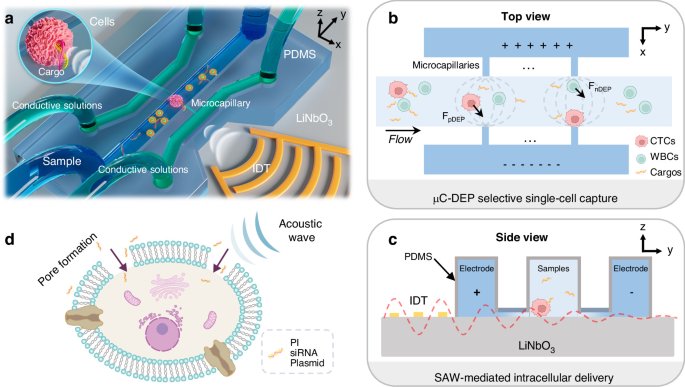
The μC-ASSIST chip first traps selected cells and then briefly opens their membranes so molecules can enter. Think of it as a carefully controlled loading dock: the capture stage holds a chosen cell in place, and the delivery stage gives cargo a temporary route inside. This membrane opening, called poration, is intended to be transient rather than permanent.
The device combines a lithium niobate base with a molded fluid channel. Microcapillaries connect the main channel to two side channels filled with a conductive liquid, which acts as three-dimensional electrodes. This arrangement creates strong, uneven electric fields near the capillary openings without requiring conventional metal electrodes patterned on the chip surface.
The electric fields produce a force called dielectrophoresis, or DEP, which moves cells according to their electrical properties and size. By tuning the field’s frequency, the team could trap A549 cells while white blood cells continued through the channel. At a different frequency, both cell types were captured, underscoring that cell selection depends on operating conditions.
Acoustic waves deliver the cargo
After capture, high-frequency surface acoustic waves, or SAWs, drive the delivery step. These waves travel along the chip surface and create conditions that temporarily permeabilize the cell membrane. The team used the approach to deliver propidium iodide, a small fluorescent dye, small interfering RNA (siRNA), which can reduce the activity of a chosen gene, and plasmid DNA carrying a fluorescent reporter.
Across the reported delivery tests, cell viability was 83.7% and transfection efficiency was 78.1%. Transfection means getting genetic material into cells so it can affect their activity. The researchers also delivered siBcl-xL, an siRNA targeting the Bcl-xL gene, and reported reduced target messenger RNA expression and less tumor-cell motility.
Why This Matters
Isolating a rare cell and changing its contents are often separate, hands-on tasks. Combining them in one workflow could help researchers examine how specific cells respond to genetic interventions, while limiting the sample handling that can cost time or lose cells. The reported results show that the chip can connect selective capture with delivery in a laboratory setting.
The study does not establish how the platform performs with patient samples or in clinical use. Its capture and delivery results are promising technical measures, but they do not by themselves show that the device can support diagnosis or treatment. Further work would need to test the system across more complex samples and establish how consistently it can isolate and manipulate target cells.
The team’s next challenge is to determine whether this combined workflow can be applied reliably to the kinds of samples and experiments that single-cell research requires. For now, μC-ASSIST offers a way to capture a chosen cell and deliver molecular cargo without moving it to a separate device.
Topics: Microfluidics · Cancer
Start here: Microfluidics explained
Related articles
- Circulating Tumor Cell Detection for Therapeutic and Prognostic Roles in Breast Cancer
- Integrated “Lab-on-a-Chip” Microfluidic Systems for Isolation, Enrichment, and Analysis of Cancer Biomarkers
- Deep-Learning-Assisted Integrated Microfluidic Platform for Automated Analysis of EV RNA Mutations
- Multifunctional microfluidic chip for cancer diagnosis and treatment