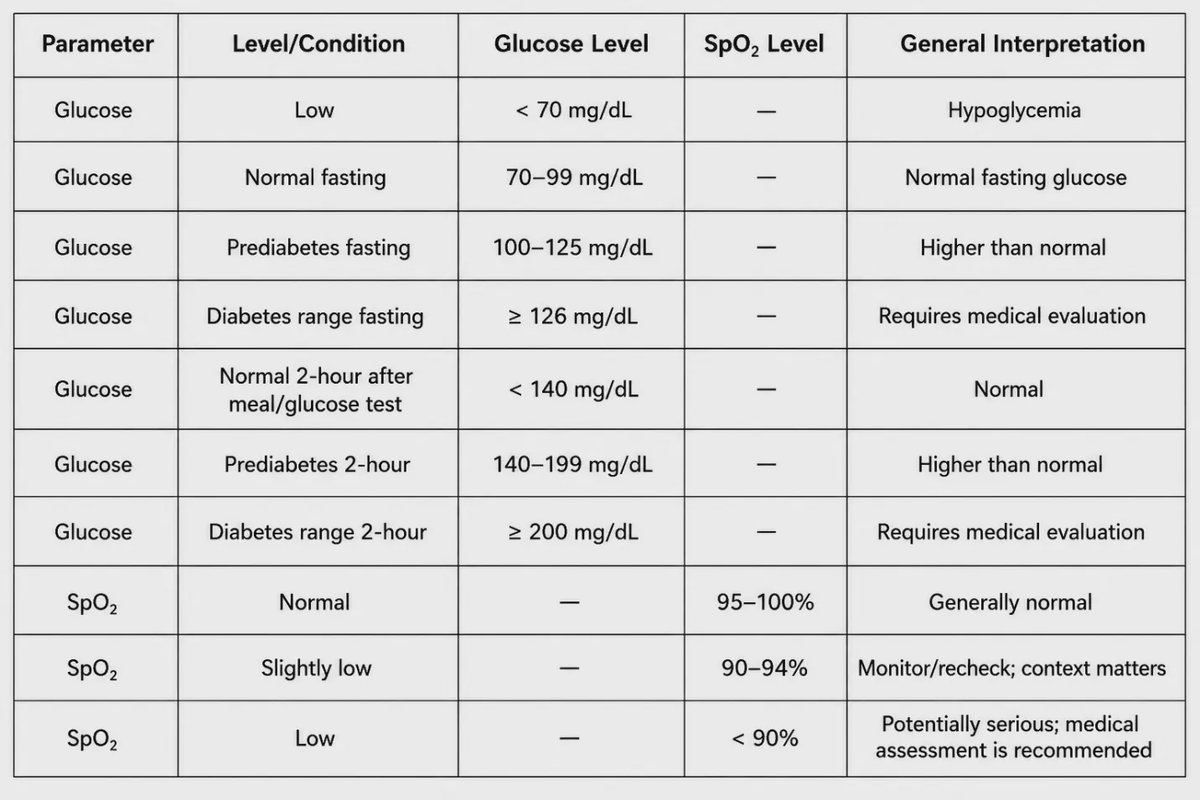
Source: International Journal of Scientific Research and Technology, by Sivasubramanian A.; Jothiswar B.; Sudharsan S.; Deepak Lara L. (October 10, 2026). AI-generated summary by biochip.com, published . Not independently reviewed.
Key takeaways
- K. Ramakrishnan College of Technology researchers designed an Arduino Uno prototype for SpO2, heart-rate, and experimental glucose-related optical measurements.
- The system combines a MAX30102 sensor, infrared LED, photodiode, OLED display, buzzer, and HC-05 Bluetooth module.
- The infrared glucose estimate is educational only and has not been clinically validated as a blood-glucose measurement.
A team at K. Ramakrishnan College of Technology has outlined a compact biosensor prototype that combines oxygen saturation, heart-rate, and experimental glucose-related optical measurements in one Arduino-controlled device. The system uses a MAX30102 optical sensor for blood oxygen saturation and pulse, plus an infrared LED and photodiode circuit intended to estimate a glucose-related signal without a finger-prick blood sample. Readings appear on a small display, trigger a buzzer at programmed thresholds, and can be sent to a phone through Bluetooth. The work matters as an educational demonstration of how low-cost electronics can bring several physiological sensing functions into a single connected platform, while stopping short of a clinical glucose monitor.
One Controller, Several Signals
The prototype centers on an Arduino Uno, a widely used microcontroller board that acts like the system's traffic director. It collects signals from sensors, processes the readings, controls the display and buzzer, and passes data to a Bluetooth module.
A 0.96-inch OLED display presents oxygen saturation, heart rate, estimated glucose values, and system status. An HC-05 Bluetooth module transmits the readings to a mobile phone, while a piezoelectric buzzer gives an audible warning when a reading crosses a programmed limit.
How the Oxygen Sensor Works
For oxygen saturation and heart rate, the design uses a MAX30102 sensor. This module relies on photoplethysmography, an optical technique that shines light into a finger and detects tiny changes in the amount of light returning as blood pulses through tissue.
It is similar to watching the rhythm of waves at a shoreline: the changing signal reveals the pulse. Pulse oximetry uses optical information to estimate the proportion of hemoglobin, the oxygen-carrying molecule in red blood cells, that is carrying oxygen. The MAX30102 connects to the Arduino through an I²C interface, a simple digital communication link used by many electronic sensors.
An Experimental Optical Glucose Channel
The glucose portion uses an infrared LED, a photodiode, and an LM358 operational amplifier. The LED illuminates tissue with infrared light, the photodiode detects an optical response, and the amplifier boosts the weak electrical signal before the Arduino reads it through an analog input.
In principle, this arrangement looks for optical changes that could be related to glucose. But the design does not establish that the resulting estimate is equivalent to a blood-glucose measurement. Skin characteristics, temperature, sensor placement, and ambient light can all alter an optical signal, which is why the system is presented as an educational and experimental setup rather than a clinically validated glucose meter.
Wireless Monitoring as a Design Goal
The phone connection is more than a convenience feature. It demonstrates a basic remote-monitoring workflow: sense a physiological signal, process it locally, show it immediately, and send it wirelessly for observation elsewhere.
The proposed design suggests future additions such as measurement histories, graphs, stored data, and notifications. Those features would require further software and validation work, but the current architecture separates sensing, processing, display, alerts, and communication into components that can be modified independently.
Why This Matters
Many health-monitoring devices measure one physiological parameter at a time. This prototype shows how an embedded platform can combine pulse oximetry with an experimental optical sensing channel and a wireless connection using readily available parts.
That integration is useful for teaching biomedical sensing because it exposes the full chain from light interacting with tissue to electronic signal conditioning, digital processing, display, and mobile transmission. The next meaningful step would be rigorous testing of measurement accuracy, repeatability, and robustness under changing real-world conditions, especially for the glucose-estimation component.
Topics: Biosensors · Diabetes & metabolism · Heart & vascular health
Start here: Biosensors explained
Related articles
- Quantum Nanosensors Could Reveal What Organs-on-Chips Miss
- Biosensors: tools for the future with a spectrum of applications
- Microfluidic Impedance Biosensor Chips Using Sensing Layers Based on DNA-Based Self-Assembled Monolayers for Label-Free Detection of Proteins
- 10 Things to Know About Organ Chips and How They Benefit Humanity