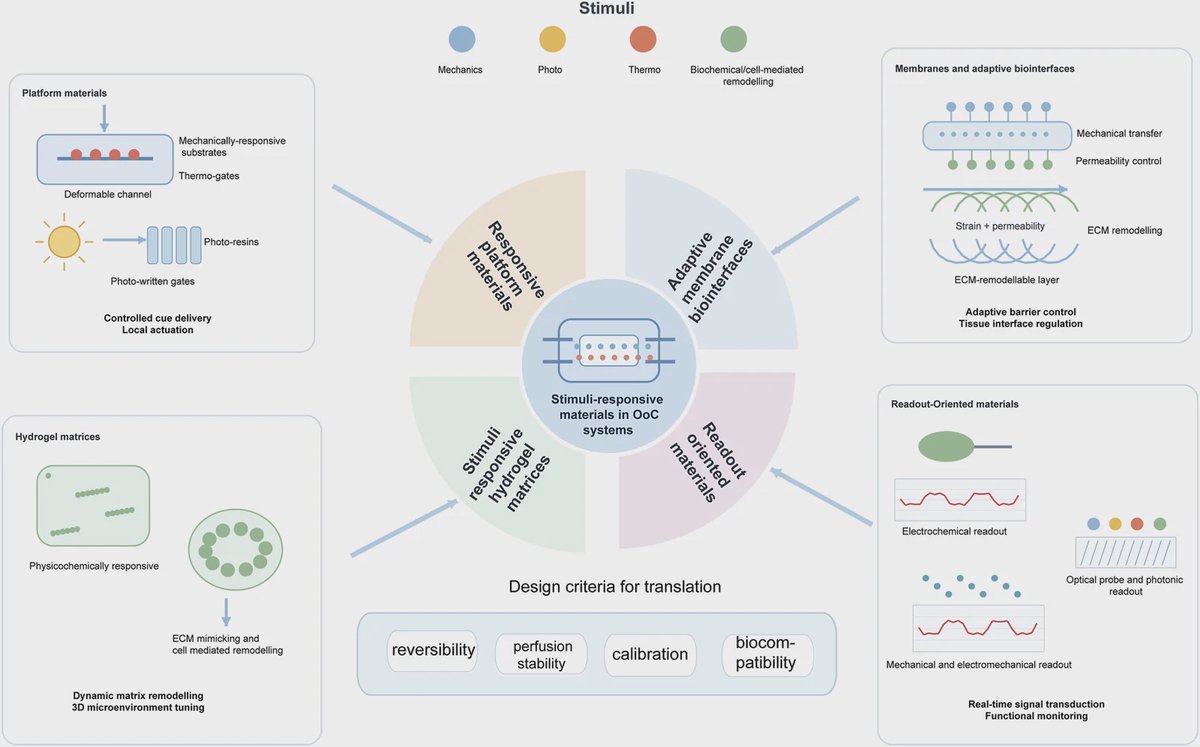
Source: Frontiers in Bioengineering and Biotechnology, by Chunmei Xian; Yuanyuan Wu; Bingqing Xie; Huangfan Xie (September 16, 2026). AI-generated summary by biochip.com, published . Not independently reviewed.
Key takeaways
- The review maps stimuli-responsive materials across four organ-on-a-chip modules: platforms, membranes, hydrogels, and readout components.
- Recent chip designs use responsive materials to support perfusion, mechanical stimulation, evolving matrices, and real-time functional monitoring.
- Material drift, calibration difficulty, batch variability, and long-term stability under perfusion remain unresolved challenges.
A review in Frontiers in Bioengineering and Biotechnology examines how stimuli-responsive materials could make organ-on-a-chip systems better at mimicking living tissues as conditions change. Chunmei Xian, Yuanyuan Wu, Bingqing Xie, and Huangfan Xie of Southwest Medical University organize the field around four parts of a chip: the platform, tissue interfaces, hydrogel matrices, and sensing components. The central idea is simple: rather than building chips from static materials, researchers can use materials that change in response to light, temperature, force, chemicals, or biological signals. That adaptability could help these miniature tissue models deliver more realistic conditions and more useful measurements for biomedical testing.
Why Static Materials Fall Short
An organ-on-a-chip is a microengineered device that maintains living cells under controlled flow, often recreating selected functions of an organ such as the gut, kidney, heart, or blood vessel. It can regulate fluid flow, chemical gradients, mechanical forces, and communication between different cell types in a compact system.
But tissues do not stay still. They stretch, stiffen, remodel their surrounding matrix, respond to changing chemical signals, and alter their electrical activity. Many conventional chip materials, including polydimethylsiloxane, known as PDMS, thermoplastics, glass, porous membranes, and hydrogels, provide useful structure but cannot readily adapt to those changes.
The review identifies several practical drawbacks: drug absorption by device materials, mechanical mismatch between a chip and tissue, limited remodeling of hydrogel matrices, sensor drift, and instability during long-term dynamic culture. A responsive material aims to narrow that gap by changing its shape, stiffness, transport behavior, or signal output when it encounters a defined cue.
A Four-Module View of Responsive Chips
The authors organize responsive materials by where they operate in an organ-on-a-chip device. This approach treats the chip less like a single object and more like a small working system in which structure, cell interfaces, tissue matrix, and measurements must function together.
Platform materials form the channels, chambers, and mechanical structures that organize cells and fluids. In the examples surveyed, mechanically responsive designs can guide organoid placement, support perfusion, deliver cyclic strain, or create vascular environments with controlled shear stress. Shear stress is the frictional force that flowing fluid applies to cells lining a vessel.
Membrane-based biointerfaces sit between tissue compartments, much like a selectively permeable wall between two rooms. Responsive interfaces could better control transport and communication across barriers, which is especially relevant to models of blood vessels and other tissue boundaries.
Hydrogels That Change With Cells
Hydrogels are water-rich polymer networks that can provide cells with a three-dimensional environment. They are often used as stand-ins for the extracellular matrix, the supportive material surrounding cells in real tissues.
The review highlights the appeal of hydrogels that respond to external or biological cues. Rather than giving cells one unchanging stiffness or structure for an entire experiment, a responsive hydrogel may evolve during culture. That matters because cells in living tissue both sense and reshape their surroundings.
An everyday comparison is a mattress that changes firmness as a person moves, instead of remaining rigid throughout the night. In an organ-on-a-chip system, a matrix with that kind of controlled adaptability could help researchers model processes such as tissue remodeling more faithfully, provided its behavior remains stable and measurable over time.
Materials That Also Read Out Function
Responsive materials can serve not only as structural components but also as functional readout elements. A readout is the chip's way of reporting what cells are doing, whether through optical, electrochemical, electrical, or mechanical signals.
Real-time monitoring is increasingly used to track barrier integrity, metabolism, electrophysiology, and mechanical function during culture. The review argues that materials capable of converting a physical, chemical, or biological change into a measurable signal could link a changing tissue microenvironment directly to a functional measurement.
This is important because a chip that applies a stimulus without measuring the biological response leaves a major question unanswered. Integrating sensing with responsive materials could allow investigators to follow how cells react over time rather than relying only on a final measurement at the end of an experiment.
Why This Matters
The review places these material strategies in the context of new approach methodologies, or NAMs, which are human-biology-based tools intended to complement or replace some conventional animal testing. It notes that regulators in China, the United States, and Europe have signaled support for evaluating such methods, including organ-on-a-chip systems, for nonclinical applications.
Still, responsiveness alone is not enough to make a chip useful. The authors emphasize that materials need to be judged by measurable improvements in stimulus delivery, adaptation of the cellular microenvironment, and functional measurement. Important unresolved issues include material drift, calibration challenges, batch-to-batch variability, and long-term stability under continuous perfusion.
The next step is to connect material behavior to tissue-level outcomes with stronger reporting and validation. If responsive platforms, adaptive interfaces, evolving matrices, and real-time sensors can be integrated reliably, organ-on-a-chip systems may become more informative tools for disease modeling and drug evaluation.
Topics: Organ-on-a-chip
Start here: Organ-on-a-chip explained
Related articles
- Microfluidic Organ-on-A-chip: A Guide to Biomaterial Choice and Fabrication
- From dietary exposure to systemic toxicity: organ-on-chip and multi-organ microphysiological systems for green food toxicology
- Organ-on-a-chip platforms for disease modeling and in vitro diagnostic applications
- A human iPSC-derived kidney–liver organ-on-a-chip platform for modeling inter-organ crosstalk