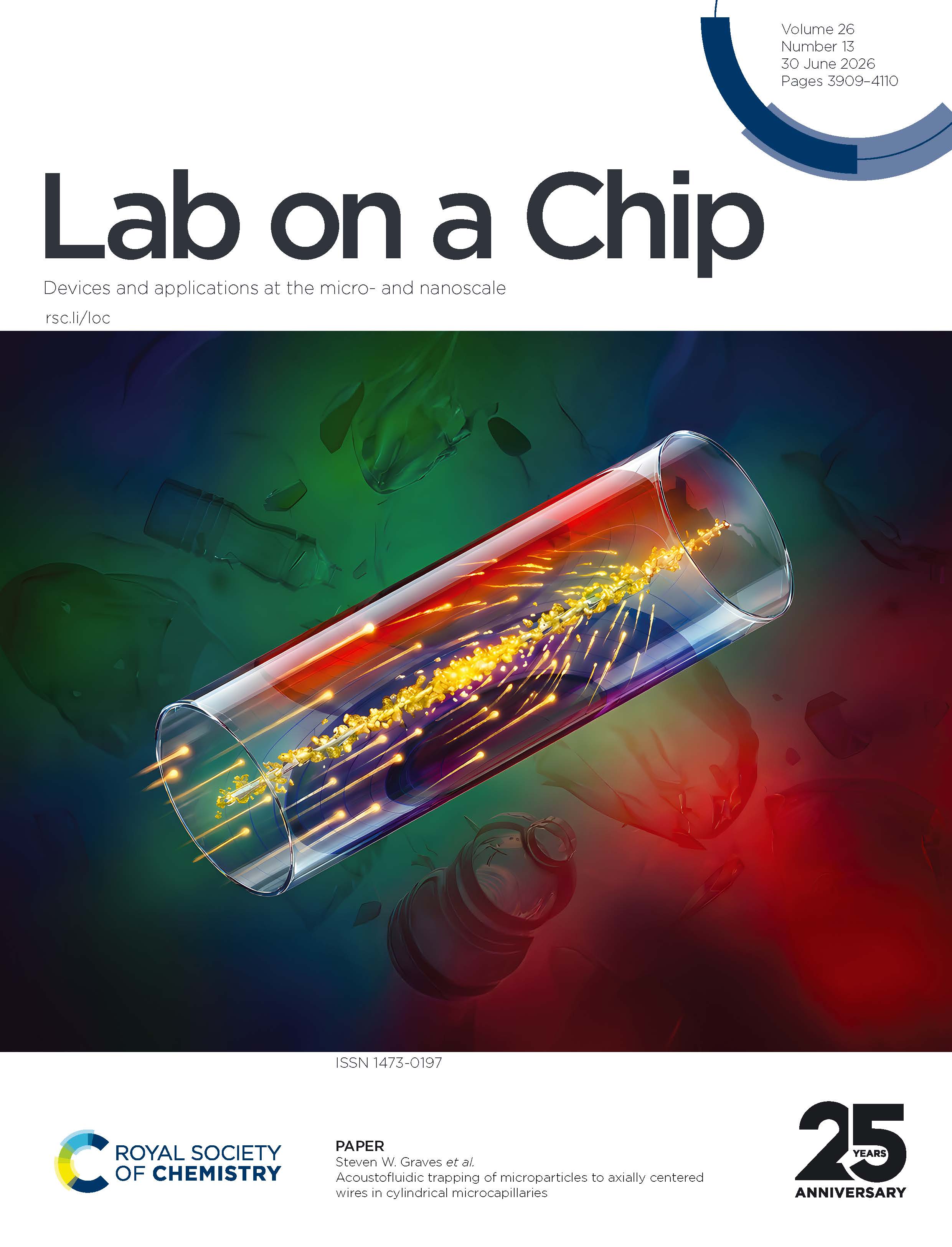
Source: Department of Chemical & Biological Engineering, The University of New Mexico (September 15, 2026). AI-generated summary by biochip.com, published . Not independently reviewed.
Key takeaways
- UNM researchers built an acoustofluidic device that directs particles to a fixed 50-micron wire in a flowing microcapillary.
- The label-free platform can capture, concentrate, and release microscopic particles for potential environmental and biomedical separations.
- The report does not establish performance in real environmental samples, clinical diagnostics, or commercial use.
Researchers at The University of New Mexico have developed an acoustofluidic device that uses sound waves to capture and concentrate microscopic particles as liquid flows through a tiny capillary. Led by postdoctoral researcher Ruben J. Trujillo, with contributions from student Rachel Bui, the work appeared in Lab on a Chip and was selected for the journal issue's inside front cover. The system directs particles toward a deliberately placed wire just 50 microns wide, roughly the width of a fine human hair. Once particles gather at that point, the device can capture them, concentrate them into a smaller volume, and release them for later analysis. The approach could help researchers isolate microplastics and nanoplastics from environmental or biological samples, where finding sparse particles in large volumes of liquid remains difficult. It may also have biomedical uses, including concentrating cells and extracellular vesicles, tiny particles released by cells that can carry biological information. Crucially, the method manipulates particles without chemical labels, potentially simplifying preparation before diagnostic, research, or analytical tests. The work brings a physical trapping structure into an acoustic field, creating a controllable way to handle particles in continuously flowing liquids.
Using Sound to Steer Particles
Acoustofluidics combines acoustics, the science of sound, with fluidics, the controlled movement of liquids. A useful analogy is a gentle current in a stream that nudges leaves toward one spot without anyone having to pick them up one by one. In this device, sound waves create forces that guide microscopic particles suspended in liquid toward a selected location inside a microcapillary.
The microcapillary is a narrow tube designed to carry a small, controlled flow of liquid. Rather than relying on a chemical tag to identify or grab a particle, the UNM setup uses physical forces from sound. That label-free handling matters when researchers want to preserve a sample's particles for later measurement or identification.
A 50-Micron Trapping Point
The distinguishing feature of the UNM system is a fixed 50-micron wire positioned within the acoustic field. The sound waves move particles toward that wire, where they can be captured and gathered. The wire acts like a carefully placed collection point in a flowing stream, allowing particles to accumulate instead of simply passing through the device.
This deliberate placement of a microstructure within the acoustic field is the reported advance. It offers a route to improve trapping while liquid continues to flow, rather than requiring particles to be processed only in a stationary sample. After concentration, the particles can be released for downstream work.
Why Concentration Is Important
Many analytical problems begin with a mismatch of scale: the material of interest may be present in very small amounts, while the liquid holding it is plentiful. Detecting tiny particles in a large water, biological, or other liquid sample can be like trying to inspect a few grains of sand spread across a swimming pool. Concentrating those particles into a smaller volume can make subsequent detection, identification, and measurement more practical.
UNM identified separation and concentration of microplastics and nanoplastics as a promising application. These particles are difficult to isolate from large liquid volumes, creating a major analytical challenge. A device that collects them before a downstream measurement could help make those later steps more effective, although the reported work does not establish a specific detection performance for plastic particles.
Potential Biomedical Uses
The same basic separation strategy could also be useful for biological samples. The researchers identified cells, extracellular vesicles, and other biological particles as possible targets. Extracellular vesicles are membrane-bound particles that cells release, and researchers often study them because they can contain molecules linked to cellular activity.
For diagnostic and biomedical workflows, sample preparation can be as important as the final measurement. Before a test can look for a rare cell or a small biological particle, it may need to separate that target from a larger volume of fluid. A label-free acoustic approach could provide a physical method for concentrating material before analytical testing.
A Collaborative New Mexico Effort
The research combined expertise from The University of New Mexico and New Mexico Tech University. In addition to Trujillo and Bui, the team included Andrew Shreve, Matthew Campen, Menake Piyasena, and Steven Graves. Their collaboration spans chemical and biological engineering and related research areas needed to build and evaluate a microscale particle-handling system.
The inside-front-cover selection gives the work visibility within Lab on a Chip, a journal focused on miniaturized technologies for chemical and biological analysis. That recognition reflects the visual and technical relevance of the platform to the lab-on-a-chip field. It does not, by itself, demonstrate readiness for clinical or environmental deployment.
Why This Matters
Particle concentration is a central challenge for many sensing systems because even a sensitive detector needs enough target material to measure reliably. By using sound waves and a fixed microscopic wire, the UNM platform addresses the physical step that comes before detection: getting widely dispersed particles into a useful collection zone. Its continuous-flow design could be particularly relevant where samples must be processed rather than handled one small batch at a time.
The system also illustrates how a small structural change can reshape what an acoustic field does. Sound provides the steering force, while the positioned wire provides a destination where particles can be trapped. Combining those two elements may give researchers a more controllable way to collect microscopic material from moving liquids.
What Comes Next
The reported technology points toward future work in environmental particle analysis and biomedical sample preparation. Its eventual value will depend on how well it performs with real-world samples, including complex liquids containing many kinds of particles. For now, the UNM team's device offers a new acoustofluidic strategy for capturing and concentrating microscopic particles before they move on to the next stage of analysis.