Source: Cancers, by Ângela Carvalho; Gabriela Ferreira; Duarte Seixas; Catarina Guimarães-Teixeira; Rui Henrique; Fernando J Monteiro; Carmen Jerónimo. AI-generated summary by biochip.com, published . Not independently reviewed.
Key takeaways
- Xu and colleagues' integrated microfluidic chip detected CTCs in 75% of 19 lung cancer patients and identified six tissue-confirmed somatic mutations in one patient.
- In trial NCT01734915, EGFR T790M was detected in 75% of tumor biopsies, 70% of CTC samples, and 80% of ctDNA samples.
- Larger clinical studies must establish robust routine performance and whether chip-derived results improve lung cancer treatment decisions.
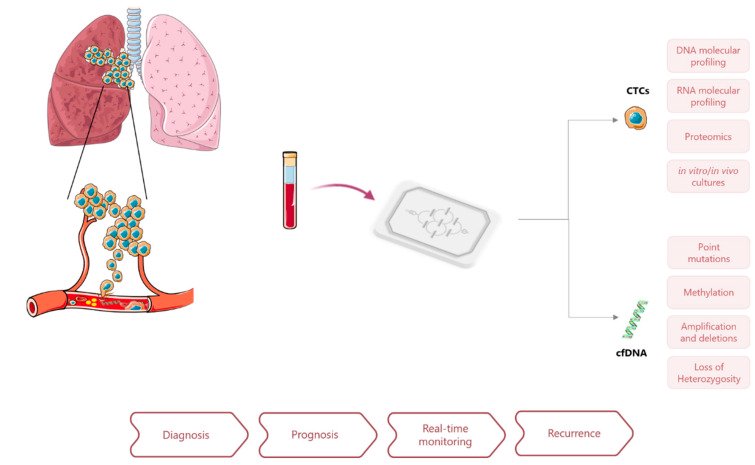
Lab-on-a-chip systems are emerging as one of the most practical ways to make liquid biopsy more useful in lung cancer, especially when doctors need tumor information without repeatedly taking tissue samples. In this research overview, the focus is on miniature microfluidic devices - tiny channels etched into a chip that guide droplets and cells much like a highly controlled plumbing system on a microscopic scale. These chips are being developed to isolate and analyze two important cancer clues in blood: circulating tumor cells (CTCs), which are whole cancer cells that have broken away from a tumor, and circulating tumor DNA (ctDNA), which is fragments of tumor genetic material floating in the bloodstream. The promise is straightforward: use a small blood draw to monitor disease, look for mutations, and potentially follow treatment resistance over time. The source article argues that chip-based systems are appealing because they can automate difficult lab steps, work with very small sample volumes, and reduce sample loss compared with more conventional workflows. It also points to early clinical validation studies in lung cancer showing that these devices can detect tumor-linked mutations with results that broadly track with tissue biopsy. That does not mean they have replaced standard pathology, but it does suggest the field is moving from clever engineering toward tools that may fit into real clinical decision-making.
Why microfluidic chips matter in liquid biopsy
Traditional tissue biopsy remains the clinical standard in lung cancer, but it has obvious limits. It can be invasive, it samples only one part of a tumor at one moment in time, and it is not always easy to repeat when a patient's disease changes.
Microfluidic chips try to solve part of that problem by handling blood samples in a tightly controlled miniature system. Think of them like a lab shrunk onto a postage stamp: channels, traps, and reaction chambers are built into the device so cells and molecules can be sorted, captured, and tested with less manual handling.
What these chips can do better
The review highlights several reasons researchers keep returning to chip-based approaches. Miniaturization makes it easier to run high-throughput tests, meaning many measurements can be performed quickly and in parallel, while automation can reduce variability from one operator to another.
These devices also tend to use smaller reagent volumes and produce less waste, which matters both for cost and for practical lab workflows. Their closed architecture can help prevent sample loss, a major issue when the target is rare, as with CTCs, which may appear only in tiny numbers in a blood sample.
CTCs and ctDNA: two different windows into cancer
CTCs and ctDNA answer related but not identical questions. CTCs are intact cells, so they can potentially reveal cell shape, protein markers, and single-cell genetics, while ctDNA offers a molecular snapshot of tumor mutations by reading DNA fragments shed into blood.
That difference is important in lung cancer, where treatment decisions often depend on mutation status. A mutation is simply a change in the DNA sequence, and some of these changes - such as alterations in the EGFR gene, short for epidermal growth factor receptor - can help determine whether a patient is likely to respond to a targeted drug.
Early clinical evidence in lung cancer
One study discussed in the source, from Xu and colleagues, used an integrated microfluidic chip for clinical CTC isolation and single-cell analysis in lung cancer. The team enrolled 19 patients and reported a CTC detection rate of 75%, suggesting the platform could recover enough tumor cells from blood to make downstream analysis possible in many cases.
The most striking part was not just capturing the cells but analyzing them one by one. In a CTC from one lung cancer patient, six somatic gene mutations were identified; somatic means acquired mutations in the tumor rather than inherited changes present throughout the body. According to the source, those results were confirmed by tissue biopsy, supporting the idea that single-cell analysis of CTCs can reflect the underlying cancer biology.
What the EGFR T790M trial showed
The review also points to clinical trial NCT01734915, launched in 2012 to study whether EGFR mutations could be detected from CTCs using a microfluidic CTC-chip. The target included the T790M mutation, a specific EGFR change often associated with resistance to earlier targeted therapies in lung cancer.
The trial was designed to compare mutation calls from tissue biopsy with those from CTCs, with the broader goal of creating a less invasive way to genotype tumors. In the resulting publication cited by the review, the investigators also analyzed ctDNA and compared all three sources - tissue, CTCs, and ctDNA - side by side.
In that comparison, T790M was detected in 30 tumor biopsies, or 75% of the biopsy samples, in 28 isolated CTC samples, or 70%, and in 32 ctDNA samples, or 80%. The authors described the results as mostly comparable across the methods, an important point because clinical confidence depends not on a chip looking elegant in the lab but on whether it agrees with the evidence doctors already trust.
What “clinical validation” really means here
Clinical validation is a phrase that can sound abstract, but the idea is simple: does a test work reliably in real patient samples, and does it measure something medically meaningful? In this context, validation means showing that chip-based liquid biopsy can recover tumor material from blood and detect relevant mutations in ways that align with tissue biopsy or other established methods.
The source stops short of claiming that lab-on-a-chip platforms are ready to fully replace conventional testing. Instead, it presents a field in transition, where proof-of-concept engineering has advanced into patient-based studies that begin to answer practical questions about sensitivity, concordance, and usefulness.
Why This Matters
Lung cancer care increasingly depends on repeated molecular testing, because tumors evolve and resistance mutations can appear after treatment begins. A blood-based assay that can be run with a small sample, processed efficiently on-chip, and matched against tissue findings could make monitoring easier for patients and faster for clinicians.
There is also a bigger lesson here for biochip technology. The value of these devices is not only that they are small; it is that they may combine capture, preparation, and analysis into one controlled workflow, reducing the weak points where rare cells or DNA fragments are often lost.
What comes next
The review suggests that the next phase for the field is not simply inventing more chip designs, but proving which ones are robust enough for routine use. That means larger clinical studies, clearer comparisons between CTC- and ctDNA-based methods, and practical demonstration that the information from these devices improves treatment decisions. If those pieces come together, lab-on-a-chip liquid biopsy could shift from a promising research tool to a standard companion for lung cancer management.
Topics: Lab-on-a-chip · Microfluidics · Cancer
Start here: Microfluidics explained
Related articles
- Liquid Biopsy in Breast Cancer: Biomarkers and Clinical Applications
- Lab-on-a-Chip Enables “Liquid Biopsy” of Cancer Cells
- Integrated “Lab-on-a-Chip” Microfluidic Systems for Isolation, Enrichment, and Analysis of Cancer Biomarkers
- Microfluidics device for high-throughput liquid biopsy and other cellular analyses