Source: Biosensors, written by Yu-Chi Wu; Kuo-Yin Lee; Hao-Pu Lin; Chin-Chuan Han; Yuan-Yang Cheng (October 21, 2026). AI-generated summary by biochip.com, published . Not independently reviewed.
Key takeaways
- A wrist-worn platform combined one muscle-signal channel, two wrist-pressure sensors, and an inertial sensor to record 12 gesture categories.
- Among 20 healthy adults, a neural network reached 81.23% average accuracy in leave-one-participant-out testing across 12,000 trials.
- The study did not test people with stroke, so clinical accuracy and rehabilitation benefits remain unestablished.
Researchers at National United University in Taiwan built a wrist-worn system that combines muscle signals, movement tracking, and pressure sensing to assess upper-limb gestures. Tested with 20 healthy adults, it classified 12 hand and wrist movement categories and highlighted where a movement differed from a reference pattern. The work matters because a gesture label alone cannot show how someone performed the movement, but the study remains an engineering feasibility test, not a clinical assessment in people with stroke.
Three sensors, one movement record
The wearable combines surface electromyography (sEMG), which records electrical activity associated with muscle contraction, with two force-sensitive resistors (FSRs) and an inertial measurement unit (IMU). The FSRs measure pressure against the wristband, while the IMU tracks acceleration and rotation. Together, the signals offer a view of muscle activity alongside the motion and contact pressure that accompany it.
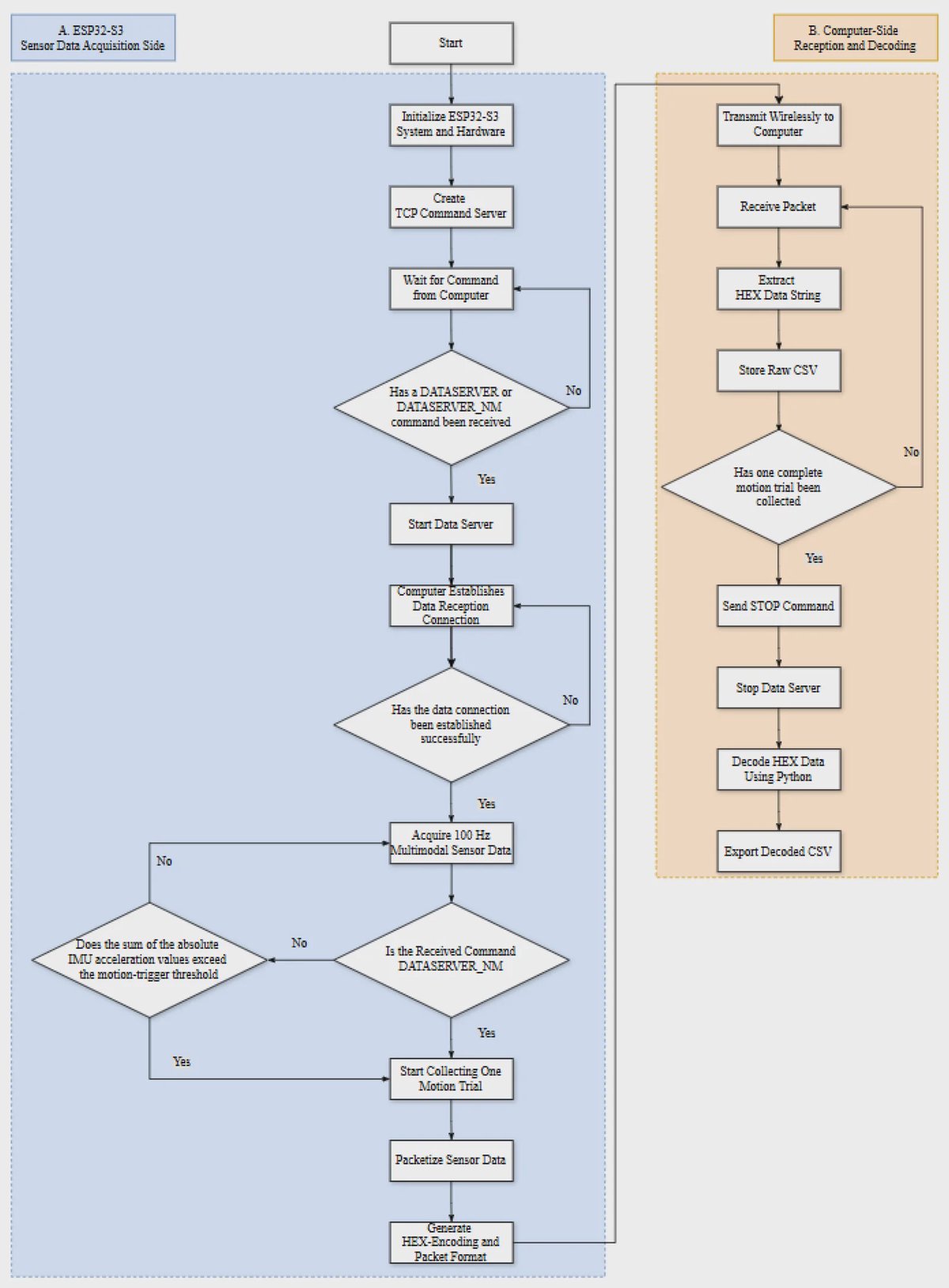
A small microcontroller synchronized the nine sensor channels and sent the data over Wi-Fi. The system collected each trial as a one-second window with 100 samples per channel. Importantly, the wristband sensors measured pressure at the wrist, not the force of the hand pressing directly on an object.
Recognizing gestures across participants
The team collected 12,000 trials from 20 healthy adults. The 12 categories covered movements such as finger flexion and extension, several kinds of grasp, wrist movement, and a resting state. A one-dimensional convolutional neural network, a type of model designed to find patterns in sequential data, classified the sensor readings.
When researchers tested the model by leaving one participant out of training at a time, it reached an average accuracy of 81.23%, with a standard deviation of 16.74%. This test asks whether a model trained on other people can recognize gestures from someone it has not seen. In a separate class-stratified random split, the model achieved a macro F1-score of 96.59%. That score summarizes precision and recall across gesture categories, giving each category equal weight; it should not be treated as equivalent to the participant-independent accuracy.
Locating differences, not just labeling them
To compare how a gesture was performed, the researchers used dynamic time warping (DTW). Think of it as lining up two recordings of the same song even when one performance is slower. Here, the method aligned sensor time series that could vary in speed, then identified segments with the largest differences, which the team called “Hotzones.”
Those segments provide a way to visualize candidate differences across muscle activity and movement signals. They do not, by themselves, establish that a movement is abnormal or explain its cause. The study describes this interpretation as exploratory.
Why This Matters
Clinical scales provide important snapshots of upper-limb function, while wearable sensors can capture repeated movement data. Combining muscle, motion, and wrist-pressure measurements could help researchers study movement patterns in home rehabilitation, including possible compensatory motions. The system’s reported processing delay after a movement ended was about 33 milliseconds, not including the one-second data window needed to capture the movement.
The next step is testing the platform with people recovering from stroke. Because the study involved healthy adults, it does not establish clinical accuracy, identify compensatory movements in patients, or show that the device improves rehabilitation outcomes.
Start here: What is a biochip?
Related articles
- Physics-informed machine learning for robust calibration and physiological validation of wearable electrochemical sweat biosensors for metabolite monitoring
- Organ-on-a-chip platforms for drug development, cellular toxicity assessment, and disease modeling
- Integrated “Lab-on-a-Chip” Microfluidic Systems for Isolation, Enrichment, and Analysis of Cancer Biomarkers
- Nanomaterials-enabled point-of-care diagnostics for pathogens