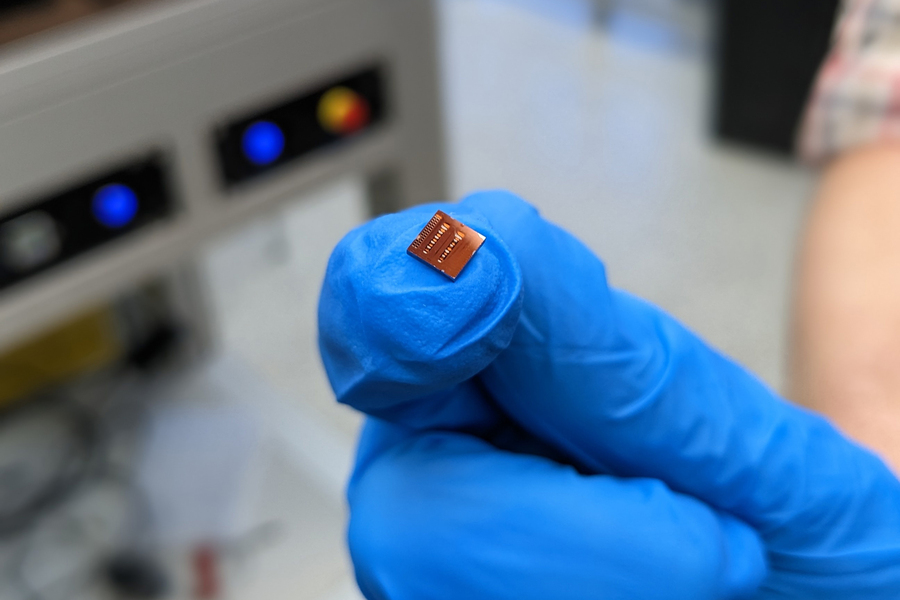
A startup founded by MIT researchers wants to move a familiar medical chore out of the clinic and into the home: routine blood testing. SiPhox Health says it has built a blood-testing system, roughly the size of a coffee maker, that uses a silicon photonic chip to measure up to 20 biomarkers from home. Biomarkers are measurable signals in the body, such as proteins or hormone-related indicators, that help doctors track disease and treatment. The pitch is simple but important: many people with chronic illnesses need frequent blood work, yet clinic visits are time-consuming enough that tests get delayed or skipped. SiPhox argues that bringing this process home could help both patients and physicians make decisions based on fresh lab data rather than symptoms alone. The company’s founders trace the technology back to their work at MIT on photonic chips and lasers, where they saw a chance to shrink bulky optical lab equipment onto something much smaller and easier to distribute. The device is not yet cleared by the U.S. Food and Drug Administration, or FDA, for clinical use, but the company is already serving patients through approved mail-in blood testing and hopes its chip-based system will eventually shorten the path from finger prick to result. At a time when six in 10 Americans live with at least one chronic disease, the effort reflects a broader push to make monitoring more continuous, less disruptive, and more useful in everyday care.
Shrinking the lab onto a chip
Traditional blood-testing machines are often large, expensive systems packed with optics such as lasers, lenses, and mirrors. SiPhox co-founder Diedrik Vermeulen says the company’s idea is not to reinvent those core measurement principles, but to miniaturize them onto a chip so the same kind of optical detection can happen in a much smaller device.
A helpful analogy is the history of computing. Early computers filled rooms and lived in specialized institutions; later, integrated chips brought much of that power into homes and pockets. Vermeulen says SiPhox is trying to do something similar for blood testing by condensing a lab-style optical system into a scalable chip-based platform.
Why chronic disease monitoring is hard today
The need is easy to understand. Many people with conditions such as hypothyroidism and inflammatory diseases must track blood markers over time to see whether a disease is stable, worsening, or responding to treatment. That usually means scheduling appointments, traveling to a clinic or hospital, getting blood drawn, and then waiting for results.
Those steps sound routine, but they add friction at every stage. Michael Dubrovsky, a SiPhox founder and former MIT researcher, says inconvenience causes some people to miss scheduled tests, and it can also affect physician behavior if doctors know patients are unlikely to follow through on frequent lab visits. In that situation, decisions may rely more heavily on symptoms, which can be less precise than direct measurement.
How the SiPhox system works
At the center of the company’s approach is silicon photonics, a technology that guides light through tiny structures etched into silicon. In everyday terms, you can think of it like building miniature roadways for light, then watching how that light changes when it encounters molecules from a blood sample. Those changes can be translated into measurements of biomarkers.
Because light-based sensing is already common in sophisticated lab instruments, the significance here is not that the concept is exotic. It is that SiPhox is trying to package that capability into a home-friendly format. According to MIT News, the company’s prototype system can produce precise readings for 20 different biomarkers, suggesting a broader panel than many single-purpose home tests now on the market.
From MIT research to a health startup
The company grew out of a long-running technical trend: taking devices once built from many separate parts and integrating them onto chips. Dubrovsky and Vermeulen met at MIT while researching photonic chip and laser technology, and they saw blood testing as a field where this integration could matter in a very practical way.
That origin story matters because it explains why the device is built around optics rather than, say, paper strips or simple electrochemical sensors. The founders are applying tools from semiconductor-style engineering to diagnostics, betting that manufacturing methods used for chips can make testing systems smaller and eventually easier to scale.
What is available now, and what is not
SiPhox’s home device is still in a research phase. The company says the chip-based system has not yet received FDA clearance, which means it is not currently authorized for routine clinical use in the way a cleared diagnostic device would be. That distinction is crucial, because promising technical performance does not by itself mean a tool is ready for medical decision-making at scale.
At the same time, SiPhox is not starting from zero in patient services. The company already offers mail-in blood testing using approved technology, both directly to people with chronic diseases and through healthcare and wellness businesses. In other words, it is building the future product while operating within today’s regulatory pathways.
The promise and the practical hurdles
If the system reaches homes, the biggest benefit may be timing. Instead of waiting days around an appointment and lab processing, patients could potentially gather data much closer to the moment a doctor needs it. That could be especially useful for conditions that require regular trend tracking rather than one-time diagnosis.
But home testing also raises practical questions. Any such system must be easy to use, reliable outside controlled lab settings, and clear about what happens after a result appears. A machine can generate numbers, but patients and clinicians still need a workflow for interpretation, follow-up, and integration with regular care.
Why This Matters
Home diagnostics often focus on convenience, but in chronic disease care convenience can become a clinical issue. When testing is hard to access, people may monitor less often than their condition requires, and small changes that show up in blood work can be missed until symptoms become obvious. A system that lowers that barrier could shift care from reactive to more continuous management.
The broader significance is that this is not just one more consumer gadget story. It points to a future where advanced measurement tools, once confined to centralized labs, are distributed closer to patients. If SiPhox and similar efforts succeed, the most important change may be invisible: better decisions because useful data arrives more often and with less effort.
What comes next
For now, the key milestone is regulatory and technical validation. SiPhox will need to show that its chip-based device can deliver dependable results in real-world use and meet the standards required for FDA clearance. If it can, the company may help redefine what routine blood testing looks like for millions of people who currently have to organize their lives around the lab.