Source: Lab on a Chip, by Soongwon Cho; Michael Brothers; Ziyu Chen; Samet Şahin; Yirui Xiong; Nicole Schaeublin; Doug Adkins; Charles Call; Anthony Banks; Steve S Kim; John A Rogers. AI-generated summary by biochip.com, published . Not independently reviewed.
Key takeaways
- A centrifugal microfluidic disc quantified human serum albumin in airborne bioaerosol samples within 15 minutes using 12.5 microliters of sample.
- Passive capillary and siphon valves automated sandwich ELISA steps, while electrochemical amperometric detection produced results similar to conventional 96-well plate ELISA.
- The platform was demonstrated only with human serum albumin, requiring validation with complex targets and real deployment conditions.
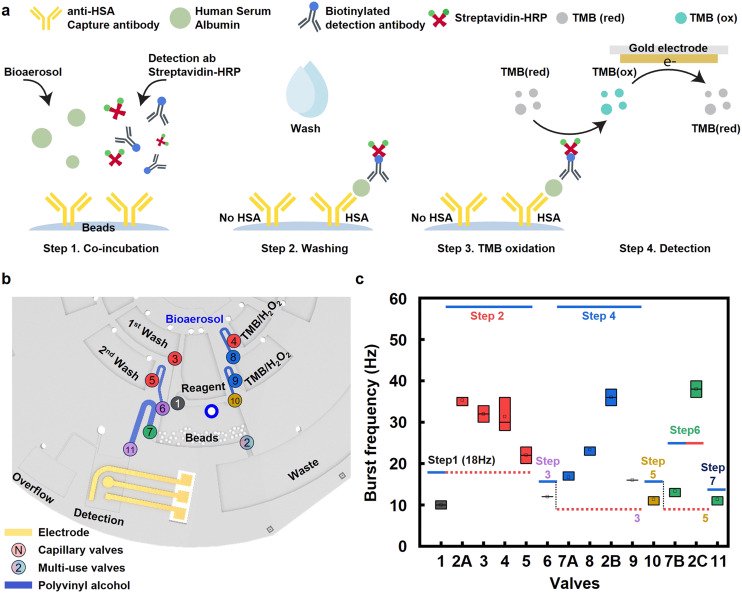
Researchers have built a centrifugal microfluidic device that can measure a target molecule in airborne biological particles in about 15 minutes using just 12.5 microliters of sample. The work focuses on human serum albumin, or HSA, a common protein used here as a model analyte, and shows that the compact system can quantify it in collected bioaerosol samples with results similar to a standard 96-well plate ELISA. Bioaerosols are tiny airborne particles from living sources, and they can range from harmless fragments to allergens or disease-carrying material. That makes fast, reliable testing important at the point of exposure, especially when a delayed or incorrect reading could lead to the wrong response. The challenge is that the best-established lab methods are accurate but awkward to use outside the lab because they involve multiple careful liquid-handling steps. By moving that process onto a spinning microfluidic disc that uses built-in valves to control fluid flow, the researchers aimed to automate the assay without giving up specificity. Their study also examined how to shorten the test by tuning valve behavior and reaction times, including the periods used for antibody binding and signal development. The result is a small, integrated platform that points toward faster field testing for airborne biological threats.
Why bioaerosols are hard to test
Testing bioaerosols is not as simple as asking whether the air contains biological material. The air is full of particles that may be harmless, mildly irritating, or genuinely dangerous, and a practical device needs to tell those categories apart rather than just flagging everything biological.
That distinction matters because false positives and false negatives have real consequences. A false alarm can trigger unnecessary countermeasures, while a missed signal can leave people exposed to a pathogen or other harmful agent.
Why ELISA is useful but inconvenient
The researchers built their system around the sandwich enzyme-linked immunosorbent assay, better known as a sandwich ELISA. In simple terms, it works like a two-lock security system: one antibody captures the target, and a second recognition element confirms it, which helps prevent mistaken identification.
That double recognition is why ELISA remains a gold-standard method for detecting proteins, bacteria, and viruses. But in ordinary practice it is labor-intensive, requiring several separate steps that are usually performed by hand, which limits its value for point-of-care or field use.
How the spinning chip works
Centrifugal microfluidics uses rotation to push liquids through tiny channels on a disc-shaped device. You can think of it as a mini laboratory on something that spins like a record, where the timing and direction of fluid movement are controlled by the chip design rather than by a technician with a pipette.
In this study, the device relies on passive capillary and siphon valving networks. Capillary forces are the same basic effect that lets a paper towel pull up water, while a siphon valve is a built-in structure that holds or releases liquid at the right moment during spinning. Together, those features automate the multiple assay steps needed for detection.
What the team optimized
The researchers did not just show that the device could run an assay; they also studied which parts of the workflow most affected total test time. One focus was the siphon valve mechanism, since fluid has to move in the proper sequence for the assay to work reliably.
They also tested the co-incubation time for HSA with both the capture antibody and the detection antibody linked to streptavidin-horseradish peroxidase, abbreviated strep-HRP. Horseradish peroxidase is an enzyme commonly used in assays because it converts a chemical substrate into a measurable signal, acting a bit like a reporter that announces when the target has been found.
How the readout is generated
For signal generation, the system uses tetramethylbenzidine, or TMB, together with strep-HRP and reads the result by electrochemical amperometric detection. That phrase sounds complicated, but the basic idea is straightforward: the chemistry produces an electrical current, and the size of that current reflects how much target analyte is present.
Electrochemical readouts are attractive for portable devices because electronics can be compact and fast. Instead of relying on a bulky optical reader, the device can translate the biochemical reaction into a direct electrical measurement.
What the device achieved
The fully integrated platform quantified HSA concentrations in 15 minutes from a sample volume of only 12.5 microliters. That is a very small amount of material, which is important when airborne samples are hard to collect or contain only limited analyte.
Just as important, the researchers report that the device successfully measured HSA in bioaerosol samples and produced results similar to those from a conventional 96-well plate ELISA. That comparison matters because standard plate ELISA is a familiar benchmark for accuracy and sensitivity.
Why This Matters
The main promise of this work is not simply faster testing; it is faster testing that keeps the core strength of ELISA, which is specificity. Because sandwich ELISA depends on two biorecognition elements, it is well suited to reducing false positives, a crucial requirement when devices may be used to assess possible airborne health threats on site.
A practical fieldable assay also needs automation. By integrating fluid handling, timed reactions, and electrochemical detection into one centrifugal microfluidic format, the device addresses one of the biggest barriers between a good laboratory assay and a useful real-world tool.
What comes next
This study was demonstrated with HSA, a model target, but the broader concept could be adapted to other proteins or biological markers relevant to environmental monitoring and exposure assessment. The next step will be showing that the same combination of speed, specificity, and small sample use can hold up for more complex targets and real deployment conditions, where portable bioaerosol testing could make a meaningful difference.
Topics: Microfluidics
Start here: Microfluidics explained
Related articles
- Machine Learning and Centrifugal Microfluidics for Bedside Sepsis Prediction
- Engineers Fabricate Microfluidic Chips for Biomedical Applications
- Recent Advances in Microfluidic Chip Technology for Laboratory Medicine: Innovations and Artificial Intelligence Integration
- Microfluidic diffusional sizing in bioanalysis and biosensing