Source: Micromachines, by Yanbin Ma; Fangjie Shu; Meng Wang; Di Yu; Yuhang Wang; Zongren Yue; Chunzhi Sun (September 16, 2026). AI-generated summary by biochip.com, published . Not independently reviewed.
Key takeaways
- Shangqiu Normal University built a vision-assisted arc-discharge platform for making cascaded microbubble resonators on one silica capillary.
- A 16-cavity array contained 12 microbubbles with optical Q-factors exceeding 10^7.
- The work does not demonstrate detection of specific analytes or performance in a real-world sensing application.
Researchers at Shangqiu Normal University have built a vision-assisted arc-discharge system that fabricates highly symmetric microbubble resonator arrays on a single silica capillary. These hollow optical cavities guide both light and fluids, making them a potential foundation for distributed microfluidic sensors and lab-on-a-chip devices. In a 16-cavity array, 12 microbubbles achieved optical quality factors above 107, a measure of how long light can circulate with minimal loss. The work addresses a practical bottleneck: producing repeatable, high-performance microbubbles without depending on discontinued fusion splicers or bulky carbon dioxide laser setups.
Why Symmetry Matters in a Microbubble
A whispering-gallery-mode microbubble resonator works much like a whisper traveling around a circular dome. Light loops around the thin glass wall of the bubble, and small changes in the liquid or gas flowing through its hollow center can alter that light signal.
For sensing, the bubble must be highly symmetric. Irregular shapes scatter light and reduce the resonator's Q-factor, which describes how efficiently an optical cavity retains circulating light. Thin, symmetric walls also help the device interact strongly with material inside the capillary.
Building a More Adjustable Heating System
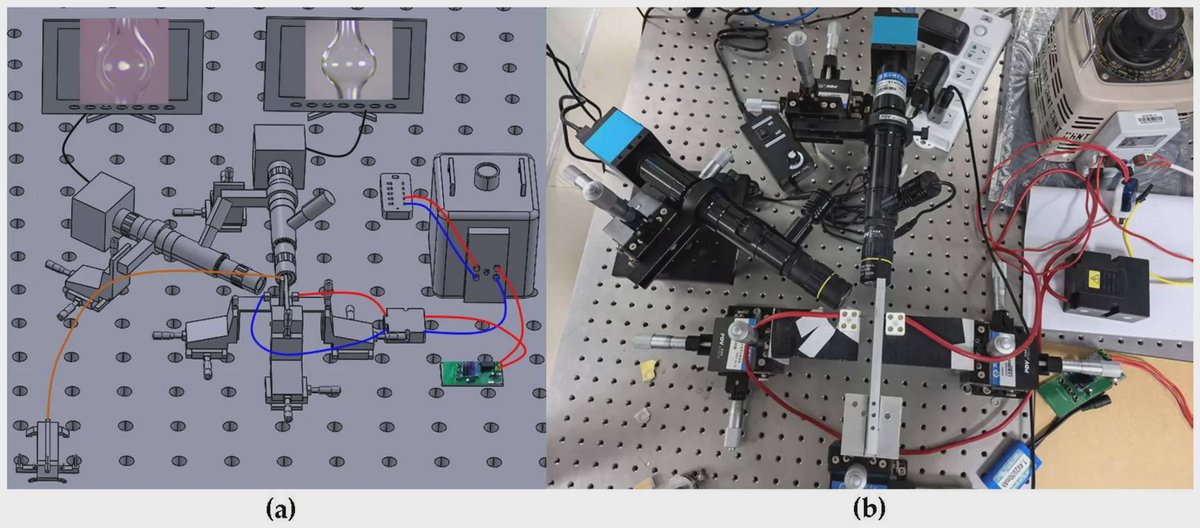
Yanbin Ma and colleagues designed their apparatus around a pair of tungsten electrodes that generate a high-voltage arc to soften a pressurized silica capillary. A three-axis translation stage positions the capillary within the arc and moves it along its length to form successive microbubbles.
The apparatus combines an adjustable AC voltage regulator, a high-voltage transformer, a microcontroller-based timing relay, a manual pneumatic pump, and a microscope with an industrial CCD camera. The camera provides live visual feedback even during bright arc flashes, allowing operators to monitor bubble expansion and alignment.
Controlling Heat and Position
The team identified two major sources of uneven expansion: transverse misalignment in the plasma arc and thermal anisotropy linked to current crowding. Put simply, the arc does not heat every part of the capillary identically, so a small positioning error can make one side of a bubble expand more than the other.
To counter this problem, the researchers used real-time spatial compensation in three directions. They also applied a two-step heating process: 165 V initially to melt the thicker capillary wall, then 125 V once inflation began. Lowering the voltage during expansion reduced arc intensity and helped prevent the thinning glass wall from bursting.
The timing controller could set each arc pulse from 10 to 1,000 milliseconds in 10-millisecond increments. Meanwhile, a manual pump supplied internal air pressure, with the reported process using a gauge pressure of 0.67 atmospheres to expand the softened silica.
From Single Cavities to In-Line Arrays
Commercial fiber fusion splicers can heat capillaries, but they are designed primarily to join standard optical fibers and offer limited freedom to reposition a capillary. Their short axial travel also makes it difficult to build a continuous sequence of resonators on one tube.
The custom stage extends that axial motion. The researchers used it to fabricate a 16-cavity in-line array, meaning multiple microbubble resonators were formed consecutively along one uninterrupted capillary. Optical tests found that 12 of the 16 individual bubbles had Q-factors exceeding 107.
Why This Matters
Arrays of hollow resonators could support measurements at multiple points along a shared fluidic channel. Rather than building and connecting many separate sensors, an in-line design could place several optical sensing nodes directly on one capillary.
The study establishes a fabrication platform and demonstrates reproducible optical performance, not a completed diagnostic assay. The next useful step will be testing how these arrays perform while detecting specific gases, liquids, or biochemical targets moving through their channels.
Start here: What is a biochip?
Related articles
- Quantitative Characterization of RNA-Splinted Ligation as a Multipurpose Post-Synthetic Strategy for High-Density DNA Microarrays Synthesized by Nucleic Acid Photolithography
- Engineered Allosteric Biosensor for In Situ DNA Glycosylase Detection in Neuroblastoma Risk Stratification and Drug Resistance Monitoring
- Automated Microfluidic System for Point-of-Care Detection of Pathogens
- Chip in a lab: Microfluidics for next generation life science research