Source: Exploration of Targeted Anti-tumor Therapy, by Pritam Saha Podder; Debasree Bhadra; Canio Martinelli; Salvatore Cortellino; Antonio Giordano; Stefano Cinti. AI-generated summary by biochip.com, published . Not independently reviewed.
Key takeaways
- Liquid biopsy for breast cancer measures circulating tumor DNA, circulating tumor cells, microRNAs, proteins and extracellular vesicles from repeated blood samples.
- Microfluidic chips, electrochemical biosensors and optical platforms aim to detect faint biomarkers faster, potentially supporting point-of-care monitoring.
- Breast cancer liquid-biopsy platforms still require standardization, head-to-head comparisons and clinical validation to prove they improve patient care.
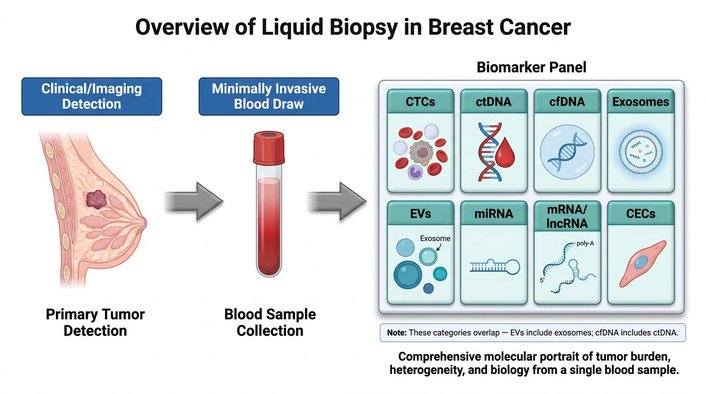
Liquid biopsy is moving breast cancer testing beyond the traditional tissue sample and toward a simple blood draw that can capture signals shed by tumors in real time. The source article reviews how this approach is being built around several kinds of biomarkers, including circulating tumor cells, fragments of tumor DNA, small RNA molecules called microRNAs, proteins, and tiny membrane-wrapped particles known as extracellular vesicles. In breast cancer, that matters because the disease is biologically diverse, can change under treatment, and is often hard to track with a single biopsy taken at one moment. A blood-based test offers a way to monitor disease repeatedly, with less discomfort and less procedural risk for patients. The review also highlights a practical shift in technology: newer biosensors, microfluidic chips, and optical systems are making these measurements more sensitive, faster, and potentially cheaper. That opens the door to wider clinical use, including in settings that do not have access to advanced molecular laboratories. The big picture is not that liquid biopsy replaces standard pathology today, but that it is becoming a useful companion tool for diagnosis, prognosis, treatment monitoring, and possibly earlier detection of relapse.
What liquid biopsy actually measures
A useful way to think about liquid biopsy is as a kind of molecular weather report. Instead of removing part of a tumor, clinicians look for traces the cancer leaves behind in blood and other body fluids.
In breast cancer, those traces can include circulating tumor DNA, which is broken genetic material released by cancer cells; circulating tumor cells, meaning whole cells that have escaped into the bloodstream; and microRNAs, very small RNA molecules that help control gene activity. The review also points to proteins and extracellular vesicles as promising sources of information because they can reflect how a tumor is behaving and responding to therapy.
Why breast cancer is a strong fit for this approach
Breast cancer is not one disease. Different subtypes can carry different molecular features, respond differently to treatment, and evolve over time, especially under drug pressure.
That makes repeat sampling valuable. A tissue biopsy gives a detailed snapshot, but only from one place and one time, while a liquid biopsy may provide a broader and more current picture of tumor burden and molecular change. For patients with metastatic disease, that could be especially useful when repeated tissue biopsies are difficult or unsafe.
The biomarker platforms gaining traction
The source article emphasizes how advances in electrochemical biosensors, microfluidic lab-on-chip devices, surface plasmon resonance systems, and nanomaterial-based optical platforms are pushing the field forward. In plain terms, these are tools designed to catch faint molecular signals in tiny fluid samples and convert them into readable test results.
Microfluidic chips are a good example. They work a bit like a highly miniaturized plumbing system etched onto a small device, moving droplets through channels so that rare biomarkers can be isolated and measured efficiently. Surface plasmon resonance, by contrast, is an optical sensing method that detects subtle changes when target molecules bind to a surface, allowing label-free measurement in some setups.
MicroRNAs are drawing particular attention
Among the biomarker classes discussed in the review, microRNAs stand out because they are relatively stable in blood and can reflect cancer-related biological changes. These molecules do not code for proteins; instead, they regulate which genes get turned on or off, so abnormal patterns may signal disease.
The references cited in the source include a 2017 study in Annals of Surgical Treatment and Research describing a serum panel of miR-21, miR-155, and miR-365 as a potential diagnostic biomarker set for breast cancer. The review also cites broader work on microRNA biology and a 2023 paper in Angewandte Chemie International Edition focused on point-of-care testing for microRNAs, showing how the field is trying to move these measurements out of specialized labs and into simpler testing formats.
From central labs to portable devices
One of the most interesting themes in the source is the effort to turn liquid biopsy into a point-of-care test, meaning a diagnostic that can be used near the patient rather than sent away for complex processing. That matters because current molecular diagnostics can be expensive, slow, and dependent on advanced infrastructure.
The review cites early work aimed at portable monitoring of circulating microRNAs, including a 2025 Discovery Oncology report on miRNA-21 in triple-negative breast cancer and a 2025 Annals of Research in Oncology paper on a point-of-care device for circulating miRNA-107 in prostate cancer. Even though one of those studies is in prostate cancer, it illustrates a broader technical trend: researchers are trying to build user-friendly devices that can detect clinically relevant biomarkers from small samples with minimal equipment.
Clinical uses are expanding, but unevenly
Today, liquid biopsy in breast cancer is most compelling as a companion to standard care rather than a stand-alone replacement. The reviewed applications include helping with diagnosis, estimating prognosis, tracking treatment response, and watching for recurrence or disease progression.
Its strongest appeal may be in serial monitoring. A patient can, in principle, have multiple blood draws over time, allowing clinicians to see whether a biomarker rises, falls, or changes pattern during treatment. That repeated measurement could reveal resistance earlier than imaging or symptoms in some cases, though the exact clinical role depends on how well each biomarker platform is validated.
Why This Matters
The significance of this field is not just scientific; it is practical. The source argues that improvements in sensitivity and selectivity have made liquid biopsy increasingly viable for clinical oncology, including in low-resource settings where sophisticated molecular diagnostics may not be available.
That could change access. If lab-on-chip systems and portable biosensors mature into reliable clinical tools, they may lower the barriers to cancer monitoring by reducing equipment needs, sample volumes, and turnaround time. For breast cancer care, where ongoing monitoring can shape treatment decisions, a simpler test could make precision medicine less dependent on geography and infrastructure.
The road ahead
The review does not suggest that every promising biomarker is ready for routine use. Different platforms still need careful standardization, head-to-head comparison, and clinical validation to show that a test result consistently improves patient care, not just laboratory performance.
Still, the direction is clear. Liquid biopsy in breast cancer is evolving from a research concept into a toolkit of measurable signals and increasingly practical devices, with microRNAs and chip-based platforms playing a central role. If upcoming studies confirm which markers are most informative and which devices are robust enough for everyday clinics, the next phase of breast cancer monitoring may look a lot less like an invasive procedure and a lot more like a smart, repeated blood test.
Topics: Biosensors · Lab-on-a-chip · Microfluidics · Cancer · Diagnostics & precision medicine
Start here: Microfluidics explained
Related articles
- Lab-on-a-Chip Enables “Liquid Biopsy” of Cancer Cells
- Companion Diagnostics in Clinical Therapy: Current Applications and Future Directions
- Integrated “Lab-on-a-Chip” Microfluidic Systems for Isolation, Enrichment, and Analysis of Cancer Biomarkers
- Microfluidic biosensors for biomarker detection in body fluids: a key approach for early cancer diagnosis