Source: Biomaterials Research, by Chaeyoun Lee; Yoonseo Choi; Hyejin Lee; Seunghee Kim; Jeong Su Park; Young Min Shin; Dae Hyeok Yang; Gun-Jae Jeong; Dong Nyoung Heo; Jeong-Kee Yoon; Junhyeong Yim; Jongmin Kim; Yonghwan Kim; Kyung Hyun Yoo; Jung Bok Lee; Byung-Chul Lee (September 3, 2026). AI-generated summary by biochip.com, published . Not independently reviewed.
Key takeaways
- The review surveys organoid and organ-on-a-chip models for the ovary, fallopian tube, uterus, cervix, and placenta.
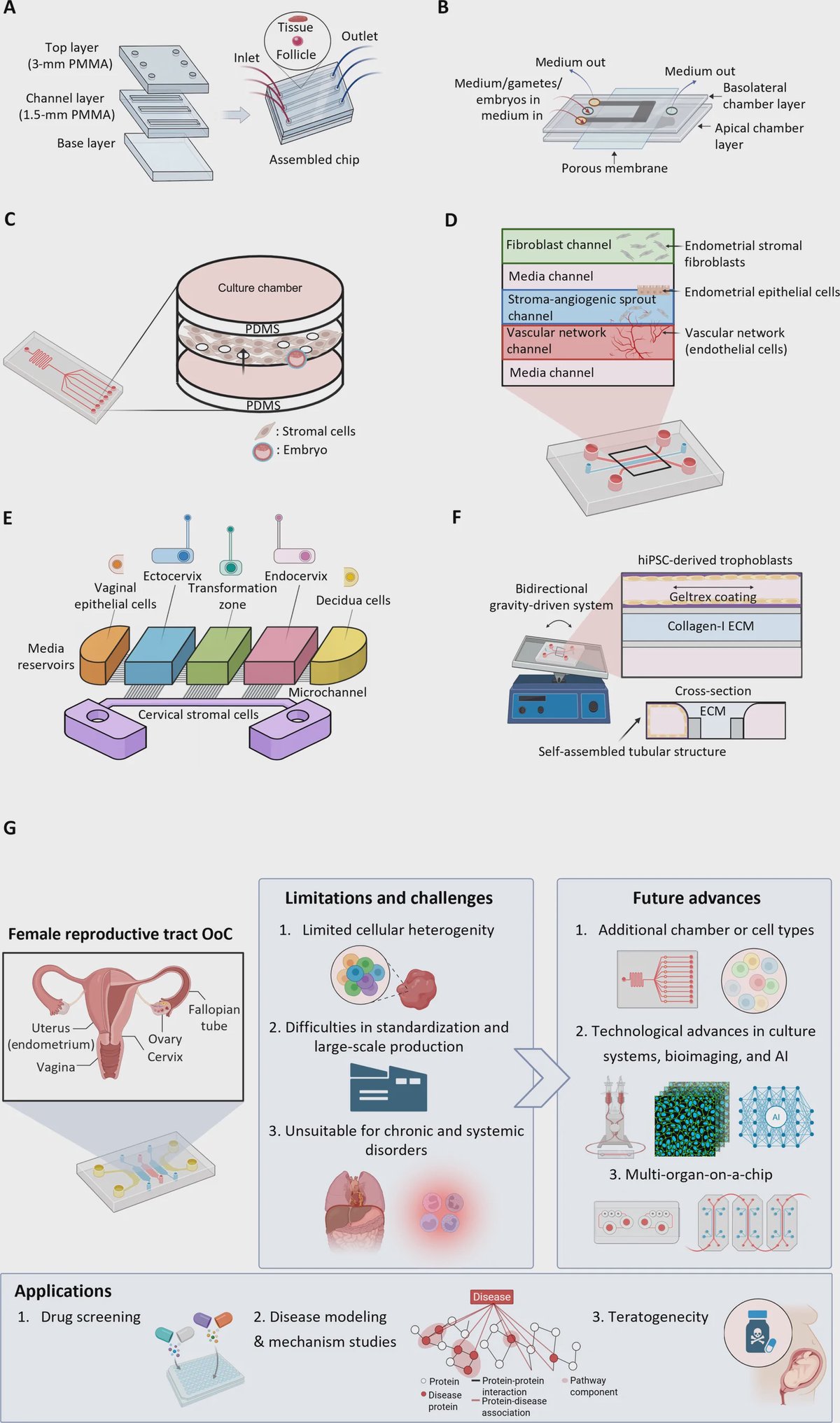
- Organ-on-a-chip systems add microfluidic flow, mechanical stimulation, and multicompartment interfaces to reproductive tissue models.
- The review does not establish a single platform that fully replicates the entire female reproductive tract.
A review in Biomaterials Research examines how organoids and organ-on-a-chip systems can model the female reproductive tract in three dimensions. Led by researchers at Sookmyung Women’s University and collaborating Korean institutions, it brings together advances involving the ovary, fallopian tube, uterus, cervix, and placenta. The central idea is that these biomimetic platforms can better reproduce human tissue structure and changing biochemical conditions than flat cell cultures or animal models. That could make reproductive research, disease modeling, toxicity testing, and preclinical drug studies more relevant to human biology.
Why conventional models fall short
The female reproductive tract coordinates ovulation, fertilization, embryo and fetal development, and childbirth across several connected organs. Traditional laboratory approaches have largely relied on mice and other animals, or on two-dimensional cell cultures in which cells grow as a layer on a flat surface.
Those methods remain useful, but each leaves out important biology. Animal studies can be limited by species differences in anatomy, genetics, and hormonal regulation, while two-dimensional cultures cannot recreate the three-dimensional architecture or dynamic chemical environment of living tissues.
Two complementary 3D approaches
Organoids are small three-dimensional cell structures grown from human-derived cells. Like a miniature, simplified version of a tissue, they can preserve epithelial identity, cell diversity, and features specific to an individual patient. They can also support long-term culture and experiments across many samples.
Organ-on-a-chip platforms add another layer of control. These microfluidic devices move fluids through small channels and can apply mechanical and biochemical signals to cells. Think of an organoid as a detailed biological model, while a chip is the plumbing and control system that can expose cells to flow, forces, and changing conditions.
The review emphasizes that chip systems can integrate multiple cell types separated by permeable membranes. This arrangement can reproduce interfaces and barriers found in native tissues, while allowing researchers to control the surrounding microenvironment more precisely than in static culture dishes.
Modeling the reproductive tract as connected organs
The review surveys models for the ovary, fallopian tube, uterus, cervix, and placenta rather than treating each organ as an isolated research problem. That broader framing matters because reproductive function depends on coordination among tissues, hormones, cells, and physical processes.
For example, the ovary contains follicles at multiple developmental stages and produces key hormones including estrogen and progesterone. Its structure and activity change across the lifespan and in response to hormonal signals, making its microenvironment difficult to replicate outside the body.
The fallopian tube presents a different challenge. It transports eggs and embryos, supports fertilization, and contains regionally distinct epithelial cells, including ciliated cells that are especially abundant toward the ovary. Models must account for this spatial organization if they are to capture how the tube functions.
Why This Matters
More human-relevant models could help researchers study infertility, pregnancy complications, and gynecological cancers without relying solely on animal experiments or simplified cell layers. Organoids offer human-specific and potentially patient-specific biology, while organ-on-a-chip devices supply flow, mechanical stimulation, and multicompartment control.
The review does not present one finished system that recreates the entire female reproductive tract. Instead, it identifies organoid and chip technologies as complementary tools whose value will depend on improving their technical and biological realism. Future platforms may increasingly combine tissue-specific models to study reproductive processes under controlled, human-focused conditions.
Topics: Organ-on-a-chip
Start here: Organ-on-a-chip explained
Related articles
- Organ-on-a-chip platforms for disease modeling and in vitro diagnostic applications
- A human iPSC-derived kidney–liver organ-on-a-chip platform for modeling inter-organ crosstalk
- Organ-on-a-chip platforms for drug development, cellular toxicity assessment, and disease modeling
- Engineering Multiscale Vasculature: Biological Principles, Design Constraints, and Advanced Biofabrication Strategies for Functional Vascular Networks