Source: Sensors (Basel, Switzerland), written by Daniel A Chamorro; María Fernanda Cadena Vizuete; Gina Layedra; Ramiro Isa-Jara; Marc A Giulianotti; Clemencia Pinilla; Maximiliano Pérez; Catalina D Alba Soto; Maria Laura Belaunzarán; Betiana Lerner; Guadalupe Gimenez (October 1, 2026). AI-generated summary by biochip.com, published . Not independently reviewed.
Key takeaways
- The microfluidic platform combined serial drug dilution with automated, label-free motility analysis of Trypanosoma cruzi trypomastigotes.
- Screening ten candidate samples identified libraries 2161-X and 2160-X as the most active, and pretreatment cut infectivity by about 50%.
- The study reports parasite assays, not evidence that either library is effective as a treatment in people.
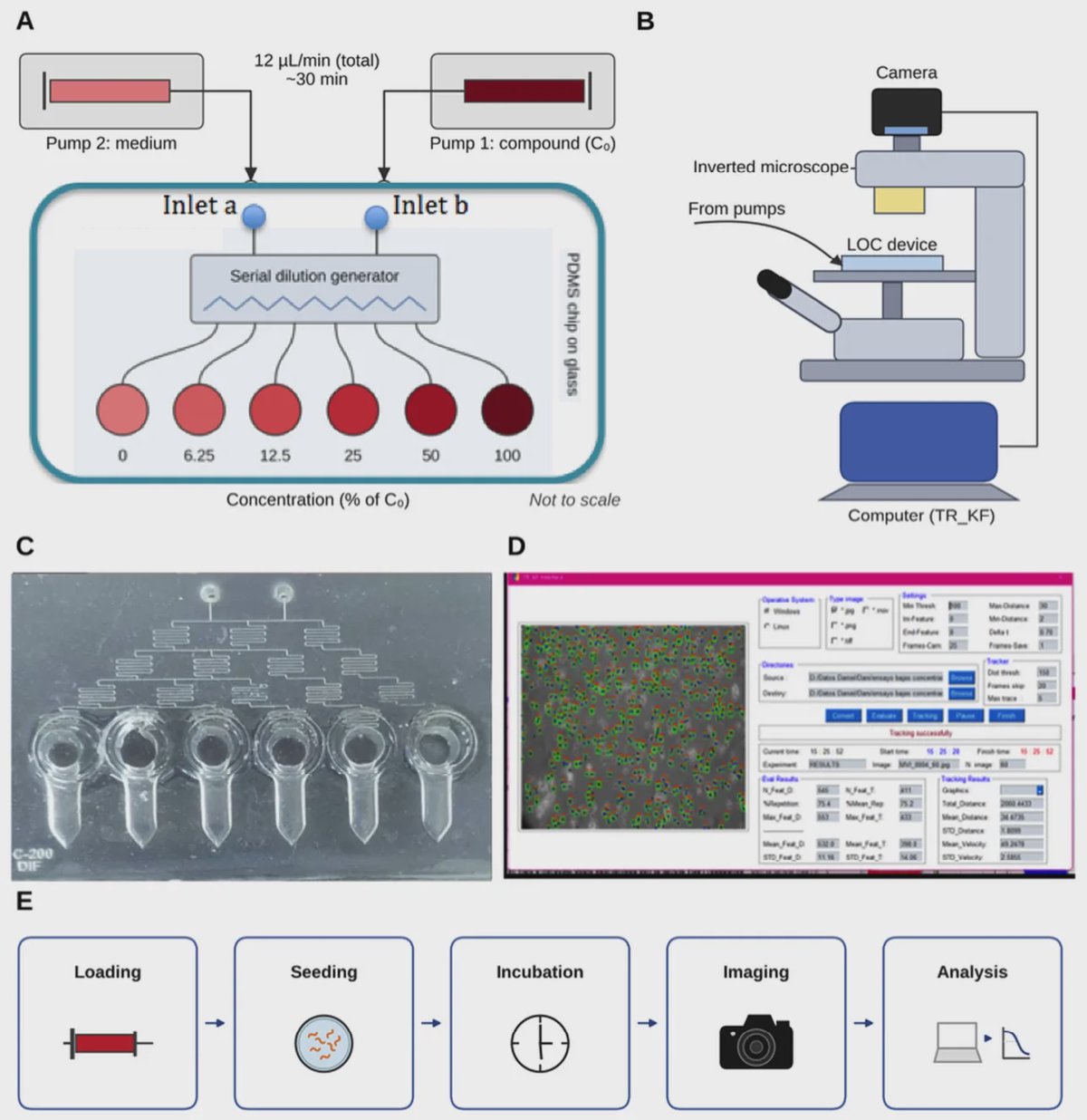
Researchers have adapted a microfluidic lab-on-a-chip platform to screen drugs against the motile, extracellular form of the parasite that causes Chagas disease. The team paired an on-chip system for making serial drug dilutions with automated, label-free analysis of parasite movement. In tests with the reference drug benznidazole, the platform produced results comparable to conventional assays. It also identified two candidate compound libraries that reduced parasite infectivity in a laboratory test.
A smaller, automated screening setup
A microfluidic device handles tiny fluid volumes through narrow channels. Here, a serial dilution generator prepares a range of drug concentrations on the chip, much like automatically setting out a row of samples with progressively lower doses. The researchers coupled that process with TR_KF, an automated method that measures parasite motility without adding a label to the parasites.
The team first compared automated motility measurements in standard 96-well plates with manual counts using a Neubauer counting chamber. The two methods produced comparable concentration-response curves and half-maximal inhibitory concentration values, or IC50 values. An IC50 is the drug concentration that reduces a measured response by half.
Next, the researchers compared the complete lab-on-a-chip and TR_KF setup with the conventional assay, again using benznidazole as the reference drug. The chip-based assay produced an IC50 that was not significantly different from the reference method. The abstract does not report the numerical IC50 values.
Two candidate libraries stood out
After validating the approach, the team screened ten candidate samples against Trypanosoma cruzi trypomastigotes, the parasite form that circulates outside host cells. Combinatorial libraries 2161-X and 2160-X showed the strongest activity among the samples tested. A combinatorial library is a collection of related compounds assembled to explore variations in chemical structure.
The researchers also compared their findings with previously reported results for intracellular amastigotes, another life stage of the parasite. Activity differed markedly between the two stages, a reminder that a compound’s effect can depend on which form of the parasite is tested. In a separate infectivity test, pretreatment with either library reduced parasite infectivity by approximately 50%.
Why This Matters
Drug screening can consume substantial amounts of sample and reagents, and manual microscopy can make results labor-intensive and dependent on the person counting. The integrated platform combines on-chip dilution with automated movement measurements, reducing assay-solution requirements and manual handling, according to the study. Because the readout is label-free, it measures a parasite behavior directly rather than relying on a fluorescent or other added marker.
The findings support using the platform to evaluate candidate compounds against extracellular T. cruzi, while also showing why testing more than one parasite stage can matter. The reported experiments do not establish whether either library will be effective in people or how the compounds perform in clinical treatment. Further work would need to assess those questions as well as the platform’s use in broader screening.
Topics: Lab-on-a-chip · Microfluidics
Start here: Microfluidics explained
Related articles
- Microfluidic diffusional sizing in bioanalysis and biosensing
- Multifunctional microfluidic chip for cancer diagnosis and treatment
- Integrated “Lab-on-a-Chip” Microfluidic Systems for Isolation, Enrichment, and Analysis of Cancer Biomarkers
- Microfluidics device for high-throughput liquid biopsy and other cellular analyses